



Discover the haunting secrets of a thousand-year-old fortress where Norse warriors built their stronghold and a phantom black dog still roams the halls
Picture this: a dramatic red sandstone castle perched on its own little island, connected to the mainland by just a narrow causeway. Waves crash against ancient walls while seabirds circle overhead, and somewhere in the ruins, the spirit of a massive black dog pads silently through corridors that have witnessed over a millennium of history. Welcome to Peel Castle, where Viking legacy meets supernatural legend in one of the most atmospheric destinations you’ll ever visit.
A Viking Stronghold Built for Kings
When King Magnus Barefoot of Norway conquered the Isle of Man in 1098, he knew exactly what he was doing. This wasn’t just any Viking raid – this was strategic empire-building. Magnus saw to the erection of two wooden prefabricated forts, one now believed to be in the South of the island and the other on St Patrick’s Isle.
The location was pure genius. The Isle of Man sits at the center of the Kingdom of the Isles that included the Scottish Outer Hebrides Islands, making it the perfect base for controlling sea routes between Ireland, Scotland, and England. While there were older stone Celtic monastic buildings on the island, the first Norwegian fortifications were built of wood.
But this wasn’t just another military outpost. The Vikings established a parliament on the island known as the Tynwald, possibly the oldest continuous parliament in the world. That’s right – while most of Europe was still figuring out how democracy worked, the Vikings had already set up shop with a functioning government that’s still operating today.
From Wood to Stone: A Castle Evolves
In the early 14th century, the majority of the walls and towers were built primarily from local red sandstone, which is found abundantly in the area. This gave the castle its distinctive rose-red glow that earns Peel the nickname “rose red city” – and trust me, when the sunset hits those walls, you’ll understand why photographers go crazy here.
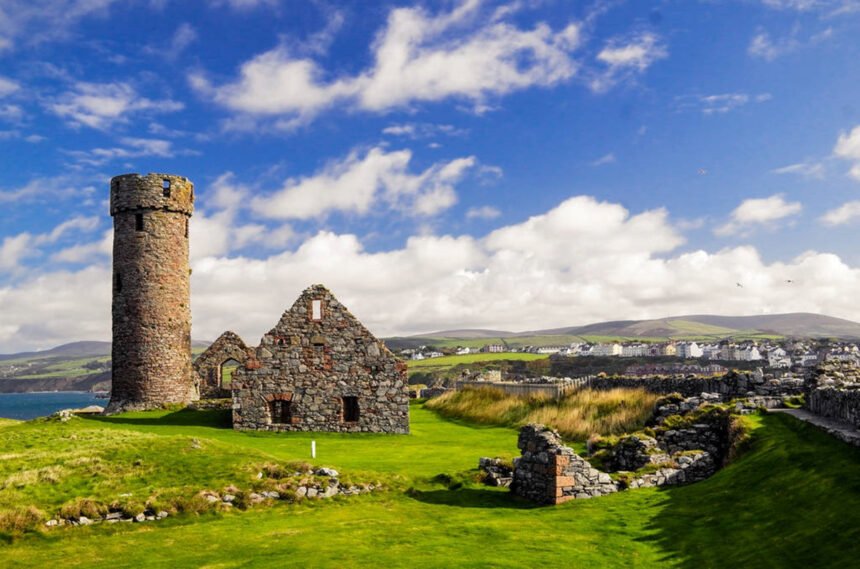
The prominent round tower was originally part of the Celtic monastery, but had battlements added at a later date. It’s a perfect symbol of how this place layers history upon history – Irish monks, Viking warriors, Norman lords, and English bishops all left their mark on these stones.
The Mysterious Pagan Lady: A Viking-Age Celebrity
Here’s where things get seriously cool. Excavations in 1982–87 revealed an extensive graveyard as well as the remains of Magnus Barefoot’s original wooden fort. The most spectacular finds were the 10th century grave of “The Pagan Lady” which included a fine example of a Norwegian necklace and a cache of silver coins dating from about 1030.
But calling her just “The Pagan Lady” doesn’t do her justice. She was buried with a number of items that have resulted in it being considered the richest Viking Age female burial in the British and Irish Isles and outside of Scandinavia. We’re talking about a fine and rare necklace made up of 73 glass beads sculptured from stones from over a wide area of Europe and the Middle east – this woman had serious international connections.
The really intriguing part? The grave goods accompanying the burial consisted of a leather Pouch which had contained bronze needles, three iron knives, a pair of iron shears, a bone comb, a small stone pestle and mortar, an Ammonite fossil, two amber beads, a necklace of high-quality glass beads, and an iron rod wrapped in a goose wing.
The range of items found with her suggest that this could also be the final resting ground for a wise woman of high standing. A woman that would have dispensed advice and could have been seen by her local community as having special powers. A Volva and powerful ‘seer’ that was skilled in the working of Seidr magic.
Imagine that – a thousand years ago, a powerful Viking woman, possibly a shaman or healer, was laid to rest here with treasures from across the known world. And now you can walk where she once lived and worked.
The Moddey Dhoo: When Legends Come Alive
But if the Viking history isn’t enough to give you chills, wait until you hear about the castle’s most famous “resident.” In the Manx folklore, of the Isle of Man there is reputed to be a ghost dog, known as the Moddey Dhoo that has haunted the grounds, rooms and corridors of Peel Castle since the reign of Charles II of England.
“Moddey Dhoo” meaning “black dog” in Manx – and this isn’t your average friendly neighborhood mutt. They say, that an apparition called, in their language, the Mauthe Doog, in the shape of a large black spaniel with curled shaggy hair, was used to haunt Peel Castle; and has been frequently seen in every room, but particularly in the guard-chamber, where, as soon as candles were lighted, it came and lay down before the fire in presence of all the soldiers.
The story gets properly spine-tingling when you hear what happened to one particularly brave (or drunk) soldier. Waldron reports that one drunken guard of the castle, who in defiance of the dog, went against the usual procedure of locking up the castle gate in pairs and did this all alone. The Moddey Dhoo got up calmly from its place by the fire and followed him. A couple of tense minutes passed before the most terrifying screams and wails resounded from the passage. Three days later he died.
That was the last sighting of the dog. But the passage was sealed up and never used again after the haunting, and a different pathway constructed.
More Than Just Castle Walls
What makes Peel Castle absolutely unmissable isn’t just one thing – it’s how everything comes together. The biggest and most complex heritage site on the Isle of Man enclosed within a 700m long curtain wall, there are almost two hectares of fortifications built over 700 years, together with a cathedral, a church, chapels and cemeteries.
Although St Germain Cathedral is in ruins, it is still impressive and the walls are still standing. Many features of Romanesque architecture, as well as the cathedral’s crypt and old Reliquary of St Germain, can still be seen. Pro tip: don’t miss that crypt – it’s genuinely atmospheric and was once used as the Bishop’s prison, housing Sabbath breakers for short periods. This crypt was, and remains, dank, dark and cheerless.
Planning Your Viking Adventure
Getting There: Peel is on the west coast of the Isle of Man and is easy to get to from Douglas, the capital of the island. The castle sits on St Patrick’s Isle, connected by a causeway that adds to the whole dramatic arrival experience.
What to Expect: Peel Castle is an open-air heritage site with stepped entry and uneven ground. Wear good walking shoes and be prepared for some serious rabbit holes (seriously, they warn you about this). Experience all areas of the castles history and key periods with the audio guide to bring it to life – the narration is genuinely excellent and brings all these stories to life.
Best Photo Ops: The views from the castle are panoramic, with sweeping views of the town of Peel and out over the Irish Sea. The Castle also provides panoramic views over Peel and out to the Irish Sea, where you may even be lucky enough to spot the local seals and maybe even basking sharks if you’re really fortunate.
Why Peel Castle Should Be on Your Bucket List
This isn’t just another castle ruin. This is where you can literally walk in the footsteps of Viking kings, stand in a medieval cathedral that once held power over an entire sea kingdom, and maybe – just maybe – catch a glimpse of the Isle of Man’s most famous ghost.
Peel has a population of 5,500 and is a sleepy fishing town, but don’t let that fool you. This place packs more history, legend, and pure atmospheric drama per square meter than almost anywhere else in the British Isles.
Whether you’re a history enthusiast fascinated by Viking expansion, a ghost hunter hoping for a supernatural encounter, or just someone who appreciates jaw-dropping views and authentic medieval atmosphere, Peel Castle delivers in spades.
And who knows? As you explore those ancient passages and climb those weathered stone steps, you might just understand why the Moddey Dhoo chose to make this magical place his eternal home. Just remember – if you see a large black dog padding silently through the ruins, maybe don’t follow it alone into any dark passages. Some Viking legends are better left undisturbed.
Ready to explore more of the Isle of Man’s incredible Viking heritage? Check out the Tynwald Hill, where that ancient parliament still meets every year, or visit the Manx Museum to see the Pagan Lady’s stunning necklace up close.


