

Ever wondered what happens when aristocratic grandeur meets agricultural education? In the charming village of Sędziejowice, Poland, you’ll find one of the country’s most fascinating examples of adaptive heritage – a historic noble mansion that has been transformed into an agricultural school, telling a story that spans centuries of Polish history.
- Why Sędziejowice Should Be on Your Poland Itinerary
- The Story Behind Poland’s Manor-School Phenomenon
- Architecture That Tells Stories
- What You’ll Experience Today
- The Broader Polish Manor Experience
- Planning Your Visit
- The Bigger Picture: Why This Matters
- Beyond the Mansion: Sędziejowice’s Other Attractions
- The Takeaway
Why Sędziejowice Should Be on Your Poland Itinerary
Situated in the Łódź Voivodeship of central Poland, Sędziejowice lies approximately 11 kilometres southwest of Łask and 43 km southwest of the regional capital Łódź. This isn’t just another pretty village – it’s a place where history literally comes alive in brick and mortar.
The village gained historical significance during the January Uprising, when on August 26, 1863, it was the site of the Battle of Sędziejowice, in which Polish insurgents led by General Edmund Taczanowski defeated Russian troops. But today, visitors come for a different kind of discovery – the remarkable transformation of aristocratic estates into centers of learning.
The Story Behind Poland’s Manor-School Phenomenon
Here’s something that might surprise you: about a thousand mansions in Poland are currently schools, rural health centers or apartments of random tenants. This wasn’t an accident – it’s the result of one of the most dramatic social upheavals in European history.
After World War II, Stalin and his agents issued the PKWN decree on agricultural reform in September 1944: all landowners lost their land and were forcibly evicted. These magnificent estates, once the pride of Polish nobility, suddenly needed new purposes. Many became schools, and agricultural schools were particularly popular choices.
The transformation makes perfect sense when you think about it. These manor houses were originally working manor houses that played a key functional role in their local economies and communities: they typically possessed their own large farms and served as venues from which other nearby agricultural production was managed.
Architecture That Tells Stories
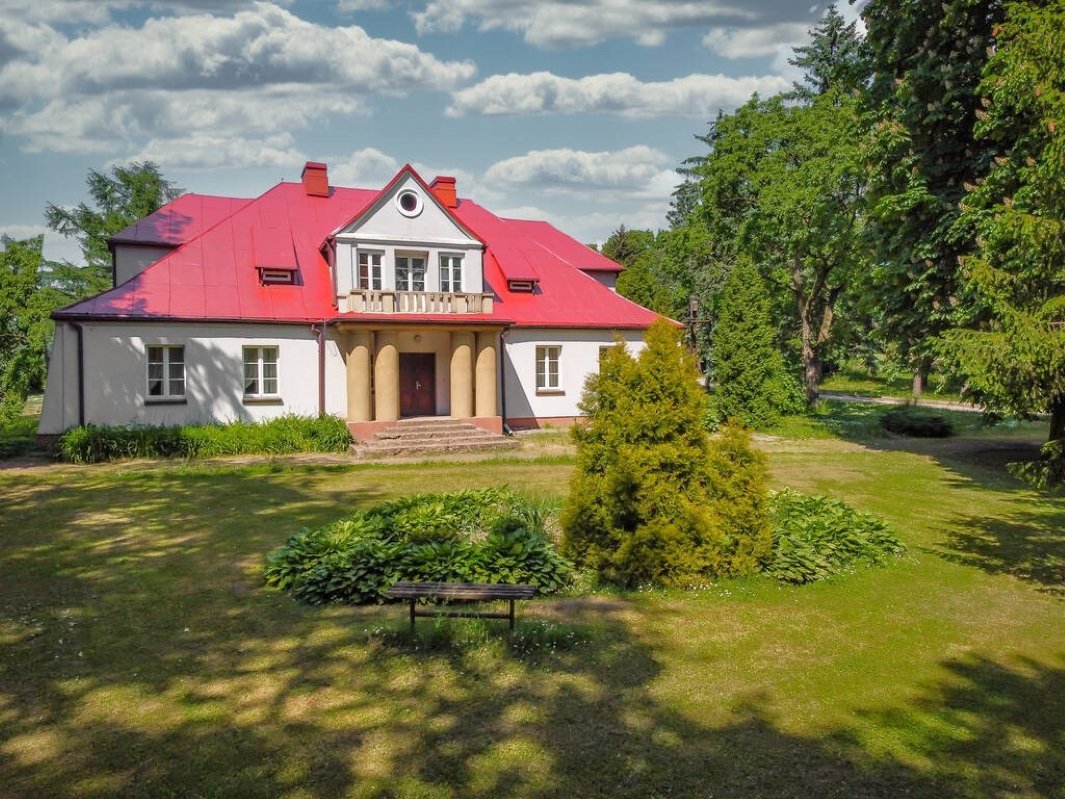
The historic mansion in Sędziejowice represents the classic Polish dwór architectural style – charming and characteristic features of the Polish landscape whose basic design dates back to the Polish Renaissance.
What makes Polish manor houses unique? Unlike other European countries with their massive palaces, Poland’s landscape is dotted with thousands of relatively modest, charming dwory, each of which was the ancestral home of a particular noble family. These were built for a surprisingly large noble class – in the 18th century, the percentage of gentry in Polish society was the highest in Europe, approximately 10% of the population, compared with a European average of 3-4%.
The architectural details you’ll notice include:
- The distinctive “Polish broken roof” – a unique hip roof design
- Classical porticos with columns that became popular during the neoclassical period
- Symmetrical facades with carefully proportioned windows
- Integration with parkland and agricultural buildings
What You’ll Experience Today
When you visit the agricultural school in Sędziejowice, you’re not just seeing a repurposed building – you’re witnessing a living example of adaptive heritage. The mansion continues its educational mission, just as it did centuries ago when the manor house was the center of the village, and landowners built houses and schools for subordinate peasants.
Pro tip for visitors: While the building functions as a working school, the exterior and grounds are typically accessible for photography and exploration. The surrounding parkland often retains original landscaping elements from the estate’s noble period.
The Broader Polish Manor Experience
Sędziejowice is part of a larger story that makes Poland unique in Europe. From the original 16,000 manor houses in pre-war Poland, only about 2,800 manors from before 1939 have retained their original exterior features. Many have found new life in fascinating ways.
Some success stories include:
- The Maciejewo Palace in Western Pomerania – which operated as an agricultural school until 1982, then became a hotel, and is now being converted into an exclusive nursing home
- Various mansions throughout Poland that have become guesthouses, hotels, restaurants and conference centers
Planning Your Visit
Getting There: Sędziejowice is easily accessible by car from Łódź (about 45 minutes) or Warsaw (approximately 1.5 hours). The village is well-connected by regional roads, making it perfect for a day trip or as part of a broader exploration of central Poland’s historic sites.
Best Time to Visit: Late spring through early autumn offers the best weather for exploring both the mansion and surrounding countryside. The agricultural school setting means the grounds are most active during the academic year.
What to Combine: Consider visiting nearby Łask for additional historical sites, or make this part of a broader tour of Poland’s transformed noble estates.
The Bigger Picture: Why This Matters
The historic mansion at Sędziejowice’s agricultural school represents something profound about resilience and adaptation. These buildings have survived wars, political upheavals, and social transformations by remaining useful to their communities.
As one Polish expert noted, “manor houses were always a place for the cultivation of family traditions, noble culture, customs and the fight for Polish identity”. Today, they continue that educational mission in new forms.
For travelers, places like Sędziejowice offer something you can’t find in standard tourist attractions – authentic insight into how societies adapt and preserve their heritage through practical use rather than museumification.
Beyond the Mansion: Sędziejowice’s Other Attractions
Don’t miss the opportunity to explore the village’s connection to the 1863 uprising. The area hosts historical reenactments, and you can walk the same ground where Polish insurgents fought for independence.
The surrounding countryside offers excellent opportunities for photography, with traditional Polish rural landscapes that have changed little over the centuries.
The Takeaway
The historic mansion at Sędziejowice’s agricultural school isn’t just a building – it’s a testament to adaptive reuse done right. In a world where we often struggle to balance preservation with practical needs, Poland’s manor schools show how heritage buildings can continue serving their communities while honoring their past.
Ready to explore this hidden gem? Sędziejowice awaits, offering a uniquely Polish perspective on how aristocratic heritage can flourish in democratic, educational settings. It’s history you can touch, walk through, and understand – not just observe from behind velvet ropes.
Have you visited any of Poland’s historic manor schools? Share your experiences in the comments below, and don’t forget to save this guide for your next Polish adventure!