



TL;DR: This ancient Roman temple perched dramatically on Mount Sant’Angelo offers breathtaking coastal views, fascinating history spanning 2,000+ years, and is totally worth the uphill trek. Free parking, spectacular photo ops, and you can combine it with beach time in beautiful Terracina!
Why This Ancient Wonder Should Be on Your Italy Bucket List
Picture this: you’re standing atop a 227-meter cliff, Mediterranean waves crashing below, with the ruins of a 2,000-year-old Roman temple stretching before you. Welcome to the Temple of Jupiter Anxur – one of Italy’s most dramatically positioned archaeological sites that somehow manages to fly under most tourists’ radars.
Built between the mid-second and mid-first century BC, this ancient Roman temple was dedicated to Jupiter, who was the protector of Anxur (the original Volscian name for Terracina). But here’s what makes it special: the complex contained not just the temple but also a military camp to control the nearby Via Appia, an important road connecting Rome to southern Italy.
What You’ll Actually See (Managing Expectations)
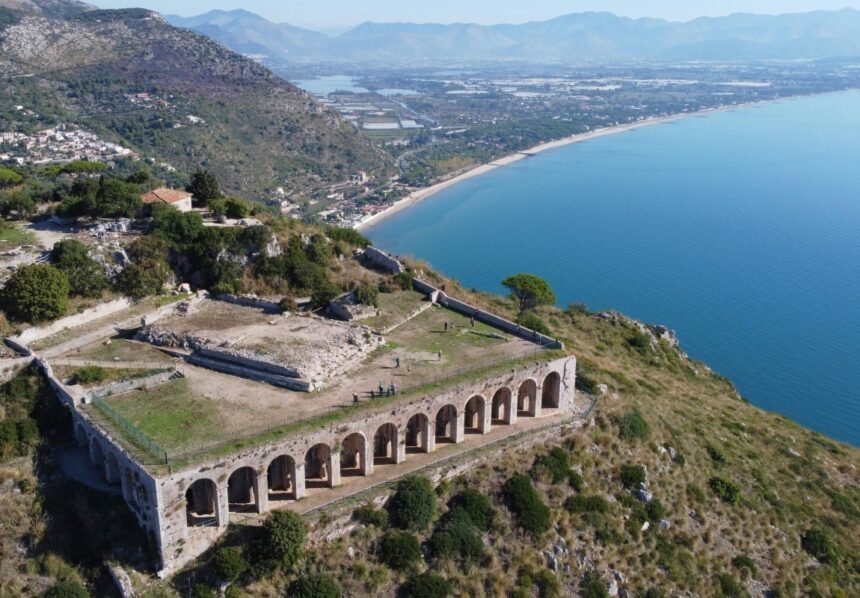
Let’s be real – if you’re expecting a perfectly preserved Pantheon, you’ll be disappointed. The main part of the temple is gone, but the impressive vaulted base can be seen for miles. What remains is absolutely spectacular though:
The Famous Twelve Arches: The upper level housed a large porch with twelve monumental arches still partially visible. These massive stone arches are the star of the show and create incredible photo opportunities.
Terraced Platforms: The site is erected on top of a terraced platform that uses opus incertum – basically, the Romans built this thing into the mountain using their signature concrete technique that’s still standing strong after 2,000 years.
The Oracle Chamber: At the external of the temple is the “oracle”, a kind of quadrilateral base with a hole from which, standing in a cave, the priests communicated the answers to the questions of the faithful. Pretty cool way to talk to the gods!
Medieval Frescoes: Bonus historical layer – in the early Middle Ages, a monastery dedicated to St. Michael the Archangel occupied the smaller temple. The interior was transformed into a church, and 9th-century frescos can still be found inside.
Getting There: Your Options
Coordinates: 41°17′28″N 13°15′35″E
By Car (Recommended)
There’s a great big free parking lot right at the temple entrance – honestly, this alone makes driving worth it. The road up is scenic but winding, so take your time and enjoy the views.
Walking from Terracina Town
Feeling energetic? To walk to the temple from Piazza del Municipio in Terracina, first head a short way down the sloping street opposite the Duomo. Take the first left uphill by the two stone funerary lions, and continue upwards, following signs to ‘Tempio di Giove Anxur’.
Fair warning: It’s an interesting walk uphill, past chunks of Roman stones, and picturesque views, but rather tiring in the heat of the day. The payoff is pleasantly quiet as it curves up through flower-strewn olive groves – absolutely gorgeous, especially in spring.
Public Transport
You can take Cotral bus services from Rome EUR Fermi; the journey takes just over two hours. For a speedier option, take a train to Monte S. Biagio station on the Rome – Naples railway line, then catch a local bus to Terracina.
When to Visit
Best Times: Spring (April-May) and early fall (September-October) offer perfect weather and those gorgeous flower-strewn olive groves. Summer can be sweltering for the uphill walk, but the coastal breeze at the top provides relief.
Time Needed: Allow 1-2 hours to properly explore the site and soak in those views. Photography enthusiasts might want longer – the lighting changes dramatically throughout the day.
Sunrise/Sunset: Early morning offers cooler temperatures and softer light, while sunset provides dramatic golden hour shots over the Tyrrhenian Sea.
Making the Most of Your Visit
What to Bring
- Comfortable walking shoes (the ancient stones can be uneven)
- Water bottle (especially in summer)
- Hat and sunscreen (limited shade on the terraces)
- Camera with extra battery (you’ll be snapping constantly)
Pro Photography Tips
The twelve arches create natural frames for spectacular shots. Position yourself on different terraces for varying perspectives of the coastline. The temple complex was highly visible all around – and those same sight lines make for incredible panoramic photos today.
Historical Context
The word Anxur is a Volscian name for Jupiter as a youth. The Volsci were an early Italic tribe that lived in the hills and marshes of the area. Mount St. Angelo, at 227 m high, stood directly in the way of Rome’s most important road. The Via Appia, built in 312 BC as a major road between Rome and Capua, ran up the steep slope of the mountain.
Combine Your Visit: Terracina Town
Don’t just visit the temple and leave! Terracina itself is a charming coastal town that’s perfect for a full day trip.
Terracina’s Historic Center
The heart of historical Terracina is Piazza del Municipio, a pretty piazza containing paving stones from the Roman Forum, a crumbling archway, the town cathedral, the headquarters of the town council and the archaeological museum.
The Cathedral
The Cathedral was built over a Roman temple to Augustus, and is an attractive building composed of a mixture of styles. It’s a fascinating example of how Italian towns layer history on top of history.
Beach Time
The modern part of Terracina spreads out on the plain below the hills, along a wide sandy beach which attracts many summer visitors. Perfect for cooling off after your temple exploration!
Pisco Montano
At the eastern end of town, below the temple on its hill, is a monument to Roman engineering and determination. To improve the route of the Appian Way, Trajan had the cliff cut to make way for the road. Traffic still runs past this 36m-deep cut in the rock, the Pisco Montano; axe-marks and Roman numerals indicate the workers’ progress. It’s literally a slice through a mountain – pretty incredible!
Food and Dining
The Terracina area is known for a product of local excellence: buffalo mozzarella. Many visitors combine temple visits with mozzarella tastings at local farms. Cheap bars and takeaways can be found along Via Roma, including the pirate-themed Morgan Bay, where you can eat your pizza slice at indoors tables.
For a proper meal, head to Via della Vittoria, which runs down to the lungomare, the seafront and is lined with restaurants serving fresh seafood.
Practical Information
Accessibility
The site involves uneven ancient stones and significant walking. While there are efforts to improve accessibility, visitors with mobility challenges should be aware that this is a hillside archaeological site.
Tours Available
Guided tours are available with local tour guides who can provide historical context about this magical place located on the top of Mount Sant’Angelo. Professional archaeologists like Professor Vencenslao Grossi offer incredibly detailed historical tours.
Nearby Islands
Ferries depart from the port for the Pontine Islands – consider extending your trip to explore these beautiful Mediterranean islands.
Why It’s Worth the Trip
This isn’t just another pile of old stones. The Temple of Jupiter Anxur offers something special: the perfect combination of fascinating history, spectacular engineering, and absolutely breathtaking views. It was then that my thoughts recalled a Bible verse I once read about putting your light on a hill for all to see. This was certainly a place to display ones most highly prized possession. Its beauty and importance could be seen by everyone for miles around.
Whether you’re a history buff, photography enthusiast, or just someone who appreciates incredible views, this ancient Roman sanctuary delivers on all fronts. Plus, it’s refreshingly uncrowded compared to Rome’s more famous attractions – you might just have those panoramic views all to yourself.
Bottom Line: The Temple of Jupiter Anxur is one of those hidden gems that reminds you why Italy is so magical. Ancient history, stunning scenery, and the chance to stand where Romans stood 2,000 years ago – all just an hour from Rome. What more could you want?