



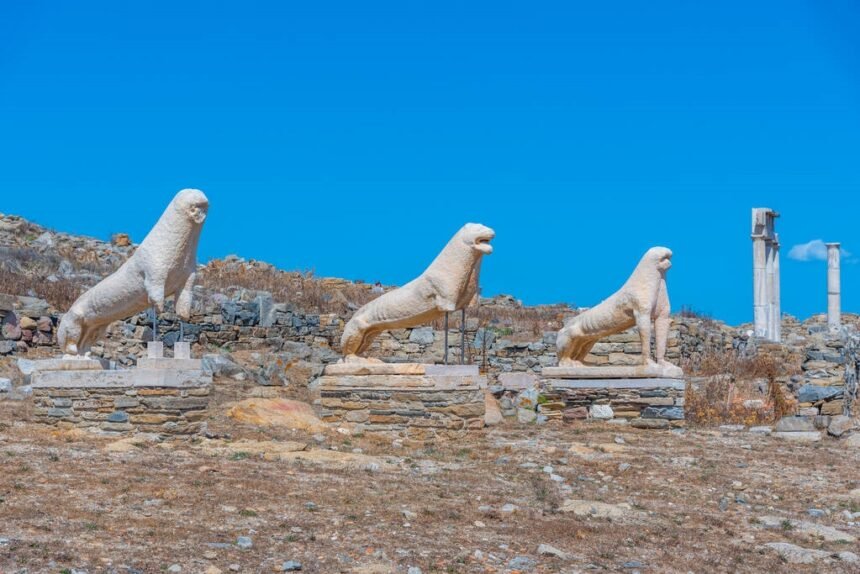
Picture this: you’re standing on a sun-baked marble terrace, surrounded by weathered lion statues that have been guarding sacred ground for over 2,500 years. Welcome to the Terrace of the Lions on Delos island – quite possibly Greece’s most underrated archaeological gem and definitely one of its most photogenic spots.
- What Makes These Ancient Lions So Special?
- Why Delos Should Be on Your Greek Island Bucket List
- Getting There: Your Delos Day Trip Game Plan
- What You’ll Actually See (Beyond the Lions)
- Photography Tips That Actually Matter
- The Real Story Behind the Stones
- Planning Your Visit: Practical Stuff Nobody Tells You
- Why Delos Beats the Usual Greek Island Experience
What Makes These Ancient Lions So Special?
The Terrace of the Lions isn’t just another pile of old rocks (though Greece has plenty of those too). These majestic marble guardians were carved by the people of Naxos around 600 BCE as a tribute to Apollo, and they’ve been striking poses longer than any influencer could dream of.
Originally, there were between 12 and 16 lions lining this sacred pathway, though today only five remain in their original positions. Don’t worry though – the missing ones aren’t lost forever. Most are safely housed in the nearby Delos Archaeological Museum, while one particularly well-traveled lion ended up in Venice (because apparently even ancient statues need a change of scenery sometimes).
Why Delos Should Be on Your Greek Island Bucket List
Here’s the thing about Delos that most travelers don’t realize: it’s essentially an entire ancient city frozen in time. While Mykonos gets all the party-goer attention, its quiet neighbor Delos offers something infinitely more fascinating – the chance to walk through what was once the most sacred island in the ancient Greek world.
The lions were strategically placed to guard the Sacred Lake (now dried up) and the sanctuary of Apollo. These weren’t just decorative pieces; they were spiritual bouncers, protecting one of the most important religious sites in the ancient Mediterranean.
Getting There: Your Delos Day Trip Game Plan
The only way to reach Delos is by boat from Mykonos, which takes about 30 minutes. Here’s the insider scoop: book your tickets the night before, especially during peak season (June through September). The boats typically run several times daily, but weather can be unpredictable, so always have a backup plan.
Pro tip: Bring water, sunscreen, and comfortable walking shoes. Delos has zero commercial development – no cafes, no gift shops, no shade. It’s just you, the ruins, and the Mediterranean sun.
What You’ll Actually See (Beyond the Lions)
The Terrace of the Lions is undoubtedly the star attraction, but don’t make the rookie mistake of snapping your photos and leaving. The entire archaeological site covers about 15 square kilometers and includes:
The House of Dionysus – featuring some of the most impressive ancient mosaics you’ll ever see. The craftsmanship will make you question everything you thought you knew about ancient art.
The Ancient Theater – still acoustically perfect after all these years. Try whispering from the stage; someone in the back rows will hear you clearly.
The Sacred Lake area – where the lions originally stood guard. Though the lake is gone, the spiritual energy of the place is still palpable.
Photography Tips That Actually Matter
Every travel blogger will tell you to visit during golden hour, but here’s reality: Delos has specific ferry schedules, so you can’t just show up whenever you want. Instead, focus on angles and composition.
The lions look most dramatic when photographed from a low angle, emphasizing their imposing presence against the brilliant blue Aegean sky. And here’s a secret most visitors miss: walk around to the back of the terrace. The view looking back toward the main archaeological site, with the lions in the foreground, is absolutely stunning.
The Real Story Behind the Stones
What makes Delos truly special isn’t just its Instagram potential – it’s the layers of history literally beneath your feet. This tiny island was once the financial center of the ancient world, a sort of ancient Wall Street meets Vatican City.
The lions weren’t just random decorations; they were part of an elaborate religious complex that drew pilgrims from across the Mediterranean. Walking among them today, you’re following in the footsteps of ancient Greeks, Romans, and countless others who made the journey to honor Apollo.
Planning Your Visit: Practical Stuff Nobody Tells You
Best time to visit: April through October, but avoid July and August if you can’t handle serious heat.
How long you’ll need: Plan for at least 3-4 hours to see the major sites properly. Rushing through Delos is like speed-reading Homer – you’ll miss all the good parts.
What to bring: Water (seriously, bring more than you think you need), sun protection, and a portable phone charger for all those photos.
Entry fee: Around €12 for adults, but prices can change seasonally.
Why Delos Beats the Usual Greek Island Experience
Look, everyone does Santorini sunsets and Mykonos beach clubs. But how many people can say they’ve stood where ancient priests once conducted sacred rituals, or touched marble carved by craftsmen whose techniques influenced art for millennia?
The Terrace of the Lions offers something increasingly rare in our hyper-connected world: genuine solitude with history. On a quiet morning, with just the sound of wind through ancient stones and the distant splash of waves, you’ll understand why the ancients considered this place sacred.
Sure, you won’t find cocktails or infinity pools here, but you will find something infinitely more valuable – a direct connection to the roots of Western civilization, guarded by lion statues that have been keeping watch for over two thousand years.
And honestly, isn’t that worth leaving the beach bar for a day?