

Where ancient stones whisper tales of monks, monarchs, and mysterious legends
Tucked away on quiet Abbey Street in Kilkenny’s medieval heart, the Black Abbey stands as one of Ireland’s most captivating hidden treasures. While crowds flock to the famous castle just down the road, savvy travelers know this 800-year-old Dominican priory holds secrets that’ll give you chills – and stories you’ll be telling for years.
A Name Shrouded in Mystery
Why “Black” Abbey? The answer isn’t as dark as you might think. Founded in 1225 by William Marshal, 2nd Earl of Pembroke, this Dominican abbey takes its name from the monks’ black habits – the distinctive black cappa worn over white robes that earned Dominicans the nickname “blackfriars.” Though some locals whisper it could be named after the Black Death that claimed eight priests here in 1348, adding an eerie layer to its already mystical atmosphere.
Viking Shadows and Ancient Echoes
Kilkenny’s story runs deeper than medieval monks. While the city itself has no reports of Viking attacks – likely protected by its position within the mighty kingdom of Ossory – the Viking legacy lurks just beneath the surface.
Just 10 kilometers away, the sinister Dunmore Caves tell a chilling tale: in 928 AD, over 1,000 people – mostly women and children – fled there to escape Viking raiders. The Norsemen lit fires at the cave entrance, and the tragic massacre became legend. When a treasure hoard of Viking silver and bronze was discovered in the caves in 1999, dating to 970 AD, it seemed the ancients were still giving up their secrets.
This Viking Triangle – encompassing Kilkenny, Waterford, and Wexford – bears witness to how these Norse seafarers shaped Ireland’s story, even in places they never conquered.
Where Two Worlds Met
Here’s what makes the Black Abbey’s location absolutely genius: when William Marshall founded it in 1225, Kilkenny was literally two towns – one Irish, one English – separated by the River Bregach. The clever Dominicans built their abbey right between them, outside both city walls, declaring their independence from either side. Talk about medieval diplomacy!
This position proved prophetic. For centuries, the abbey would become a neutral ground where cultures, politics, and faith collided.
The Cromwell Chronicles: “Cromwell’s Bed”
The abbey’s most dramatic chapter reads like a thriller novel. When Oliver Cromwell besieged Kilkenny in 1650, he didn’t just attack the abbey – he made himself at home. Cromwell actually slept in part of the church, and that section is still called “Cromwell’s Bed” today.
His soldiers ransacked the sacred space, smashed windows, ripped off the roof, and even hacked at statues with their swords. The marks are still visible on some carvings. Yet somehow, one stone slab depicting the Holy Trinity survived untouched – locals say it was because even Cromwell’s men dared not touch something so sacred.
Legends That Live On
The abbey’s folklore runs as deep as its foundations. During Cromwell’s occupation, the famous abbey bell mysteriously vanished. Centuries later, workers cleaning an estate in County Wicklow discovered a bell inscribed “Black Abbey Kilkenny 1225.” When the Protestant lady of the house refused to return it, the men of Kilkenny simply took it back, parading it through the streets with four altar servers in a decorated lorry.
Local storytellers also speak of the legendary “Kilkenny cats” – mythical felines said to fight so fiercely they consumed each other, leaving only their tails. While this tale has been told across Ireland, it became synonymous with Kilkenny’s fighting spirit. Today, “the Cats” is the proud nickname of Kilkenny’s hurling team.
Treasures That Survived the Ages
Step inside and you’ll discover Ireland’s most precious medieval survivors. The abbey houses the only known surviving wooden statue of St. Dominic in Ireland – an Irish oak carving believed to be the oldest such piece in the world. You can actually see the sword marks where Cromwell’s soldiers tried to destroy it.
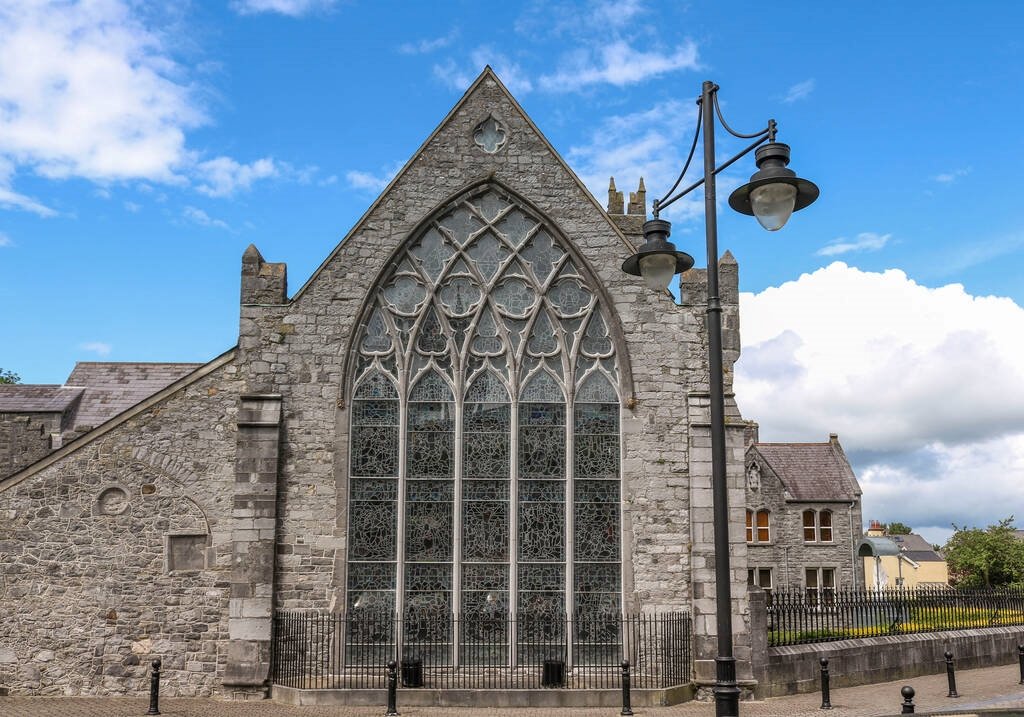
The massive Rosary Window is a stunning 45-square-meter stained glass masterpiece depicting the fifteen mysteries of the Holy Rosary. And the medieval alabaster sculpture of the Holy Trinity, dating from 1400, represents one of the finest examples of Irish religious art from this period.
A Living, Breathing Monument
What makes the Black Abbey special isn’t just its history – it’s still a functioning Dominican house and parish church where locals worship daily. Visitors often comment on the profound sense of peace that pervades the space, despite its turbulent past. When services aren’t being held, you can explore freely with an information leaflet (a small donation is appreciated).
Planning Your Visit
Getting There: The Black Abbey sits on Abbey Street, about 1km from Kilkenny Castle – an easy walk through the city’s charming medieval streets.
When to Visit: Catholic churches are typically open daily until around 7pm, though it’s worth checking Mass times on their website. The abbey is particularly atmospheric in the early morning or late afternoon when golden light streams through those ancient windows.
What It Costs: Admission is free, though donations are welcomed to help maintain this historic treasure.
Time Needed: Plan to spend up to an hour here – more if you’re captivated by the stories and atmosphere.
Beyond the Abbey Walls
The Black Abbey makes an perfect stop on Kilkenny’s “Medieval Mile.” Combine it with nearby Kilkenny Castle, St. Canice’s Cathedral with its round tower, and the Medieval Mile Museum for a full day of historical immersion.
For those drawn to the Viking connections, consider adding the Dunmore Caves to your itinerary – it’s a short drive that brings the ancient Viking tales full circle.
The Cats’ Enduring Spirit
Today’s Kilkenny embodies the same resilient spirit that saw the Black Abbey survive 800 years of triumph and turmoil. Kilkenny is possibly one of the most attractive towns in Ireland, with narrow streets lined with old-fashioned shop fronts. The Kilkenny Arts Festival in August each year is a particularly magical time to visit.
Whether you’re drawn by medieval history, local legends, or simply the promise of stepping into a place where time seems to stand still, the Black Abbey delivers an experience that’s both intimate and epic. In a country full of famous castles and crowded attractions, this hidden gem offers something increasingly rare: the chance to discover Ireland’s soul in solitude.
Come for the history, stay for the stories, and leave with a piece of medieval Ireland etched in your memory.
Pro Tip: Visit early morning or late afternoon for the best lighting for photography, and don’t miss the chance to chat with the friendly friars if they’re around – their stories bring these ancient stones to life in ways no guidebook can match.