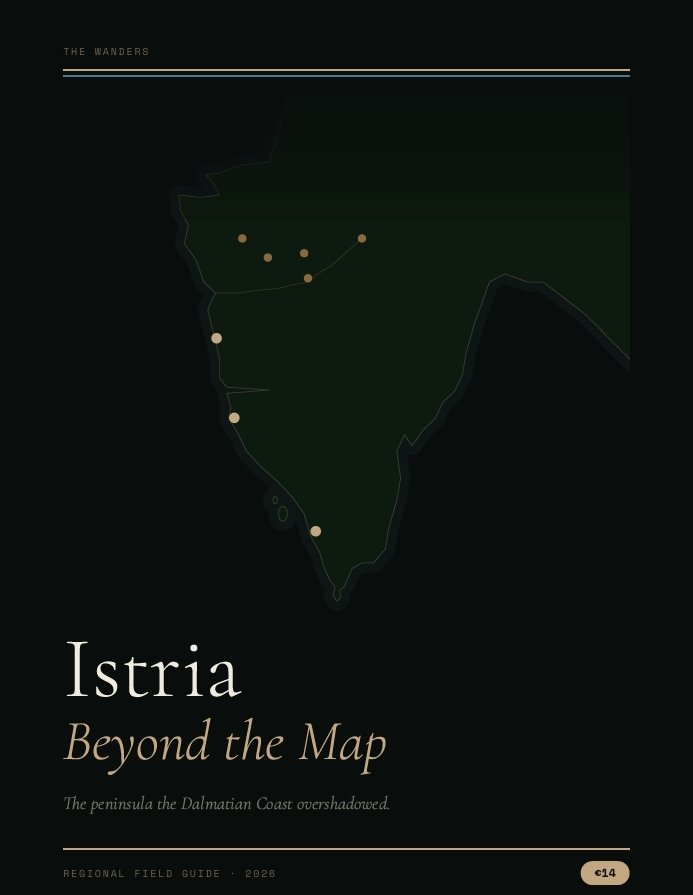
The peninsula the Dalmatian Coast overshadowed.
While Dubrovnik and Split absorbed Croatian tourism, Istria kept its Roman amphitheatre, its own grape variety, its medieval hilltop towns above a truffle forest and a coastal wilderness at its southern tip where the road ends. The result is one of the most complete travel territories in Europe — and one of the most consistently underestimated.
This guide covers the peninsula in full. Nine sites honestly assessed. The truffle season calendar. The two Istrian grapes. Seven campsites for the campervan traveller. Trail data on every hike. Sea kayaking, birdwatching and the complete festival calendar. October confirmed as the correct month — and exactly why.
Nine sites — assessed honestly
Rovinj ★★★★★ — Built on a former island. The Venetian buildings climbing to St Euphemia Church are genuinely as beautiful as their reputation suggests.
Pula Arena ★★★★★ — The sixth largest surviving Roman amphitheatre in the world. Built 27 BC–68 AD. The outer walls almost entirely intact.
Euphrasian Basilica, Poreč ★★★★★ — A 6th century UNESCO Byzantine basilica with gold-ground mosaics comparable to Ravenna’s Sant’Apollinare.
Brijuni National Park ★★★★★ — Tito’s private islands. Roman villa ruins, a Byzantine castrum, 200+ dinosaur footprints on the tidal flats (visible at low tide only — tide table required), zebras and antelope from Tito’s African diplomatic gifts still on the island.
Motovun ★★★★★ — The most extraordinary hilltop town in Istria, above the Mirna valley truffle forest.
Grožnjan ★★★★★ — Abandoned after WWII, restored by artists from 1965.
Cape Kamenjak ★★★★★ — 30 square kilometres of limestone karst wilderness where the road ends.
Limski Fjord ★★★★★ — A drowned river valley 12km long.
Parenzana Trail ★★★★ — 123km walking and cycling trail along an 1902 Austro-Hungarian railway trackbed.
The campervan guide — seven sites and complete logistics
Wild camping is illegal throughout Croatia and enforced, particularly along the coast and inside Cape Kamenjak. The guide covers this clearly and then does what no other Istrian guide does: assesses seven campsites honestly for the campervan traveller with GPS coordinates, prices, opening season and the strategic reason each one belongs in the circuit.
žnjan and Oprtalj, grey water and LPG logistics, the ACSI Card (€20/year, reduces pitch prices to €14-22 off-season) and the complete seven-night campervan circuit from Pula to Poreč.
Trail data — every hike with full specifications
The Bora wind — what every Istrian visitor needs to know
The bora (bura in Croatian) is a violent cold north-northeast wind descending from the Karst plateau above Trieste.
The complete festival calendar
Sea kayaking and birdwatching
The truffle tradition — how to attend
The two Istrian grapes — with producer logistics
Malvazija Istarska — the white variety grown nowhere else on earth in the same form. Four producers with GPS and visit logistics: Kozlović (€15-20pp, English, book ahead, 30 min from Poreč), Cattunar (€10-15pp, by appointment), Trapan (€10pp, no appointment, 20 min from Pula Airport), Roxanich (€20-30pp, the most extensive tasting in Istria). Three self-drive circuits: north, central Mirna valley, south.
Teran — the red grape that reveals itself only with food. The guide states the honest assessment and the correct pairing: Istrian prosciutto, truffle pasta, local sheep cheese.
Format and delivery
Pages:     60 · A5 portrait · PDF · fonts embedded
Price:     €14 · one-time purchase
Delivery:  Immediate download on payment
Edition:   2026 · English
Territory: Croatian, Slovenian and Italian Istria
Also from The Wanders Beyond the Map series
Albanian Riviera — Beyond the Map Field Guide · €12 Train Journeys Beyond the Map — Practical Field Guide · €14 Europe in Autumn — The Beyond the Map Guide · €14 Tbilisi Beyond the Map — City Guide · €9 São Miguel Azores Field Guide · €12 Georgia Bundle — Four Field Guides · €40