

The mistake most visitors make in Dalmatia is stopping at Hvar. The ferry from Split takes 45 minutes, the harbour is beautiful, the lavender fields are extraordinary in June and the restaurants on the Hvar Town waterfront are among the best in Croatia. All of this is true. It is also true that Hvar receives over a million visitors per year and that the island beyond the harbour town — the extraordinary agricultural interior, the abandoned villages on the northern slopes, the small fishing settlements on the southern coast — is walked by a fraction of them.
The route described here uses Hvar as a starting point rather than a destination. It moves southwest through the Dalmatian archipelago toward islands that the ferry network reaches but the tourist infrastructure has not — Vis, the most remote inhabited island near Split. Lastovo, the most remote inhabited island in the entire Croatian Adriatic. Mljet, whose national park contains two extraordinary saltwater lakes in a landscape of complete pine forest. And finally Dubrovnik — not as a cruise ship destination but as the endpoint of a journey through the extraordinary green island world that lies between it and Split.
This is the Dalmatian route that earns the Adriatic.
The route
Split → Hvar → Vis → Biševo → Korčula → Lastovo → Mljet → Dubrovnik
Eight stops. Twelve days minimum. The route moves consistently southwest and southeast — you never backtrack. Each island is more remote than the last until Lastovo, after which the route turns toward Dubrovnik via Mljet. The ferry network supports this direction naturally — Jadrolinija, the Croatian national ferry operator, runs scheduled services connecting all eight stops on the route.
Why this route specifically
The standard Dalmatian island itinerary — Split to Hvar, Hvar to Brač, return to Split — covers the most accessible and most visited islands in the Croatian archipelago. These are extraordinary islands. They are also the islands that Croatia Tourism has been marketing to northern European visitors since the 1990s and that appear in every travel magazine feature about Croatian summer holidays.
This route begins where that itinerary ends. Hvar is the gateway to the southwestern Dalmatian archipelago — the chain of islands that extends toward the open Adriatic, each one progressively more forested, more remote and less shaped by the tourist economy that has transformed the northern Dalmatian islands since independence.
Vis was closed to foreign visitors entirely until 1989 — a Yugoslav military base occupying the most strategically positioned island in the central Adriatic. The absence of tourist development during the decades when Hvar and Brač were being built into resort destinations has left Vis with an extraordinary quality: a Dalmatian island that looks and feels as the entire coast looked in the 1970s.
Lastovo went further still. The most remote inhabited island in the Croatian Adriatic — 47 nautical miles from Split, accessible by one ferry per day in high season — has 800 permanent inhabitants, one small harbour, extraordinary wine and an extraordinary medieval settlement visible only from the sea. Most Croatian island visitors have never heard of it.
The practical logistics
Ferry operators
Jadrolinija — the Croatian national ferry operator. Car ferries and passenger catamarans. The most reliable operator for the southwestern islands. Car ferries are slower, cheaper and significantly more comfortable for longer crossings. Catamarans are faster and more expensive — book in advance for high season crossings as catamaran capacity is limited.
Krilo — a private catamaran operator running the Split-Hvar-Vis corridor in summer. Faster than Jadrolinija catamarans, comparable pricing, no car transport.
G&V Line — operates the Lastovo connection from Korčula and Split. The only operator reaching Lastovo in winter.
The car decision
The route as described works significantly better without a car. The island roads on Vis, Lastovo and Mljet are navigable by scooter or bicycle — both available for hire on each island — and the absence of a car removes the complexity of car ferry booking, which requires advance reservation in high season and adds 40-60% to crossing costs.
If you need a car — take it to Hvar and Vis only, then return it to Split before continuing to Korčula, Lastovo and Mljet by passenger ferry. The national park on Mljet prohibits private vehicles in the park zone anyway.
Booking
Jadrolinija tickets available at jadrolinija.hr or at any ferry terminal kiosk. Book car ferry spaces 3-5 days in advance in July and August. Passenger catamaran tickets in advance for Vis in peak season — the afternoon Vis catamaran fills quickly with day-trippers returning to Split.
Lastovo tickets rarely sell out — the island’s remoteness means demand never reaches capacity even in peak season. This is both the warning and the attraction.
The Lastovo timing note
The ferry to Lastovo from Korčula departs once daily in each direction in high season. Miss it and you wait 24 hours. This is not a complaint. It is the condition of visiting an island that has chosen not to be convenient. Build the Lastovo crossing into your schedule with a full day of buffer on either side.
The eight islands
Split — the departure
Split is not an island but it is the most extraordinary city on the Dalmatian coast — a medieval and post-medieval city built inside the retirement palace of the Roman Emperor Diocletian, its streets and squares the corridors and courtyards of a 4th century AD imperial complex that has been continuously inhabited for 1,700 years.
Arrive in Split the evening before your first ferry. Walk the extraordinary Peristyle — the central courtyard of Diocletian’s Palace, now a square of Roman columns and medieval buildings — at midnight when the tourist coaches have gone. The Peristyle at midnight with the Cathedral of Saint Domnius lit above it is one of the most extraordinary urban spaces in the Mediterranean.
The ferry terminal is a 10-minute walk from the old city centre, directly on the waterfront. All Dalmatian island ferries depart from the same terminal — check the specific gate for your crossing.
Hvar — two days
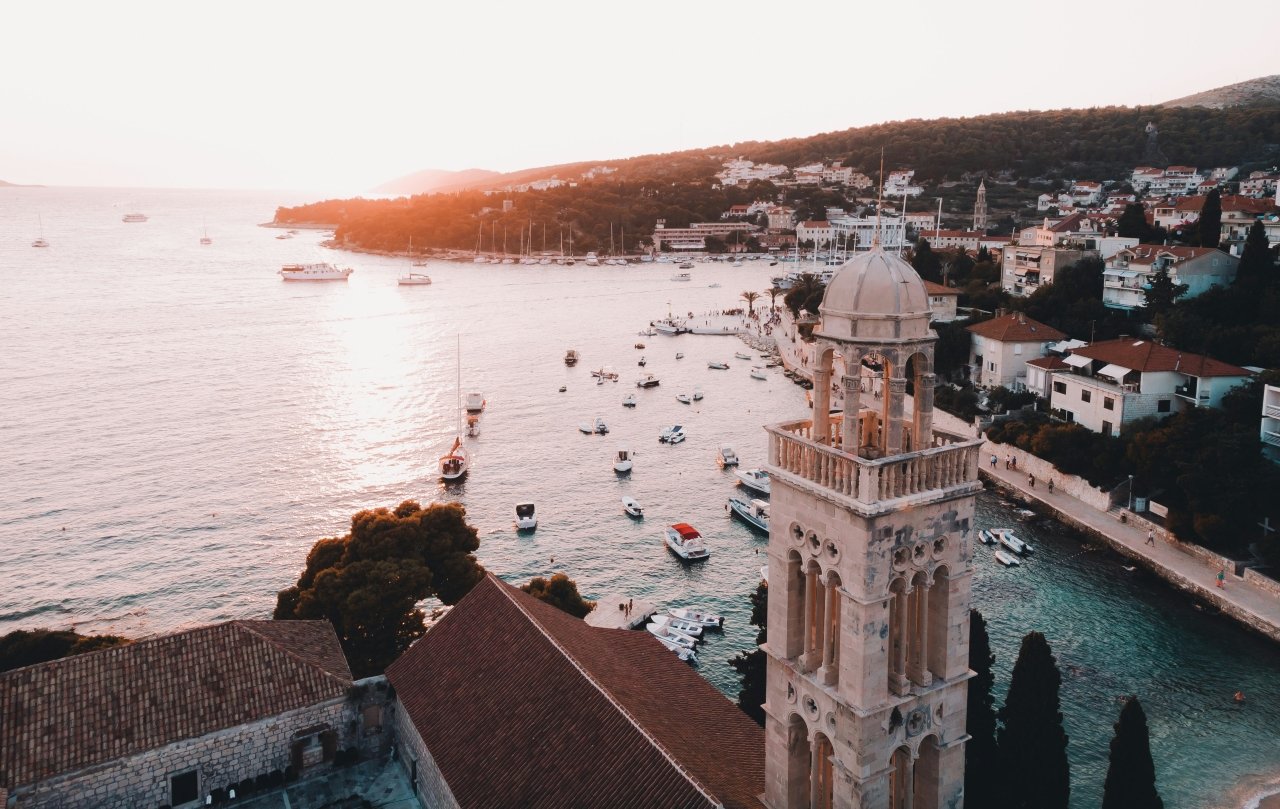
Hvar Town’s harbour is extraordinary — the medieval walls, the Renaissance loggia, the Cathedral of St Stephen with its extraordinary bell tower, the Spanish fortress above the town. It is also extraordinarily busy in July and August. Arrive on the early morning ferry from Split to have the harbour to yourself for two hours before the day-trip boats begin arriving from the mainland.
The extraordinary part of Hvar is not the harbour. It is the extraordinary hinterland — the Stari Grad Plain, a UNESCO World Heritage agricultural landscape of ancient Greek field divisions unchanged since the 4th century BC when the island was colonised from Paros. The plain is walkable from Stari Grad — the quieter, more authentically Croatian town on the northern coast — through a landscape of extraordinary historical continuity.
Spend one day in Hvar Town and one day in Stari Grad and the plain. The lavender fields that cover the central ridge of the island bloom in June and early July — the most extraordinarily scented landscape in the Adriatic.
Vis — three days
The ferry from Hvar to Vis takes approximately one hour by catamaran. The arrival at Vis Town harbour — a curve of extraordinary Venetian and Baroque architecture around a bay of remarkable clarity — is one of the most beautiful harbour arrivals in the Adriatic.
Vis Town and Komiža, on the western side of the island, are the two settlements. They could not be more different. Vis Town is Venetian in character — baroque palaces, Renaissance churches, a promenade of extraordinary quality. Komiža is a fishing village of the deepest Dalmatian character — working boats, a 16th century Venetian fortress, extraordinary lampreys, the most atmospheric small harbour on the island.
The extraordinary thing about Vis is not any single monument. It is the overall character of an island that was insulated from tourist development for four decades by Yugoslav military occupation. The wines — Vugava white and Plavac Mali red — are among the finest in Croatia. The food in the small restaurants in both towns is extraordinary. The hills above Komiža contain the ruins of extraordinary WWII installations including the cave that served as Tito’s headquarters during the Italian and German occupations — Tito’s Cave, accessible by a short hike from Komiža, is one of the most atmospherically extraordinary WWII sites in the Adriatic.
Three days on Vis: one day in Vis Town, one day in Komiža, one day renting a scooter and exploring the extraordinary interior and the military ruins.
The Biševo day trip from Komiža:
Biševo is a small uninhabited island 5km from Komiža, accessible by water taxi, whose extraordinary Blue Cave — Modra špilja — produces one of the most remarkable natural light phenomena in the Mediterranean. Between 11am and noon on clear days sunlight penetrates a submerged entrance to the cave and illuminates the interior in an intense blue light of extraordinary quality. The cave can only be entered by small boat — visitors transfer from the water taxi to a rowing boat at the cave entrance. The experience lasts approximately 10 minutes. It is worth the journey from Komiža specifically.
Book the water taxi from Komiža harbour the evening before — the cave visit depends on sea conditions and weather, so flexibility is essential.
Korčula — two days
The ferry from Vis to Korčula takes approximately 2.5 hours. Korčula Town — a medieval walled city on a small peninsula on the northeastern tip of the island — is sometimes called Little Dubrovnik, which undersells it. The medieval walls, the extraordinary herringbone street plan designed to channel sea breezes through the town in summer, the Cathedral of St Mark and the extraordinary towers and gates are a complete medieval Dalmatian city in miniature.
Korčula claims to be the birthplace of Marco Polo — a claim that most historians consider unproven but that the town maintains with extraordinary commitment, including a house identified as the Polo family residence and an annual festival. The Wanders position: the claim is contested, the house is atmospheric, the story is worth telling honestly.
The island of Korčula beyond the town is extraordinary for its extraordinary wine — Pošip white wine from the Čara and Smokvica villages in the island interior is the most distinctive white wine in Dalmatia and almost entirely unknown outside Croatia. A day in the wine villages of the interior — Čara, Smokvica, Blato — is the correct second day on Korčula.
Lastovo — two days
The ferry from Korčula to Lastovo takes approximately 2 hours. It is the longest crossing on the route and the most rewarding.
Lastovo is the most remote inhabited island in the Croatian Adriatic. 47 nautical miles from Split, 800 permanent inhabitants, one ferry per day in high season, no airport, no international hotel chain, no tourist information office in English. The harbour settlement of Luka Lastovska has a handful of restaurants and accommodation options. The extraordinary medieval village of Lastovo Town — invisible from the harbour, built on the inland hillside specifically to be invisible from the sea during the pirate centuries — is reached by a road that climbs through extraordinary pine and oak forest.
Lastovo Town is one of the most extraordinary medieval settlements in the Dalmatian islands — a cluster of Renaissance and Baroque houses with extraordinary chimneys of unusual design, a 15th century church, narrow streets of extraordinary completeness and almost no tourist infrastructure whatsoever. The town’s extraordinary Poklad carnival tradition — one of the oldest living carnival traditions in Croatia, held on Shrove Tuesday, in which an effigy representing an enemy messenger is symbolically hanged, burnt and dragged through the town — is an extraordinary Living Traditions article in its own right.
The Lastovo Archipelago Nature Park surrounding the island — 53 islands and islets of extraordinary biodiversity, extraordinary marine life in the most pristine waters in the Adriatic — makes Lastovo simultaneously the most remote and the most ecologically extraordinary island on the route.
Two days on Lastovo is enough. One day in Lastovo Town and the extraordinary viewpoints above the harbour. One day by boat through the archipelago nature park.
Mljet — two days
The ferry from Lastovo to Mljet connects via the regular Jadrolinija service. Mljet is the greenest island in the Adriatic — 75% forested, an extraordinary landscape of pine and holm oak covering an island of extraordinary quiet.
The western third of Mljet is a national park containing two saltwater lakes — Veliko jezero and Malo jezero — connected to the sea by a narrow channel and to each other by a smaller channel. The lakes are swimmable and kayakable. In the centre of the larger lake — Veliko jezero — sits a small island with a 12th century Benedictine monastery, accessible by a small boat that runs continuously between the lake shore and the monastery island. The monastery is one of the most extraordinarily positioned sacred buildings in the Croatian islands — a Romanesque church and cloister on an island within a lake within an island, surrounded by extraordinary pine forest.
Mljet requires a bicycle or a rented electric bike. The national park road around the lakes is one of the most extraordinary cycling routes in the Adriatic — flat, forested, the lake visible through the pine trees on one side and the open Adriatic on the other. The complete circuit takes approximately two hours at a comfortable pace.
Two days: one day cycling the national park lakes. One day walking the extraordinary southeastern part of the island beyond the park boundary — the abandoned village of Blato and the extraordinary cliffs of the southern coast.
Dubrovnik — arrival
The ferry from Mljet arrives at Dubrovnik’s Gruž harbour — 3km from the old city, accessible by bus or taxi. The arrival at Dubrovnik after twelve days moving through the extraordinary southwestern Dalmatian archipelago produces a specific effect: the famous walls, the famous Stradun, the famous cable car seem simultaneously more extraordinary and more manageable than they would arriving by airport transfer from London.
You have earned the walls.
When to go
June — the best month for this route. The lavender on Hvar blooms. The Blue Cave on Biševo is accessible in calm June seas. The ferry network is operational but not at peak frequency. Lastovo has enough visitors to keep the restaurants open but not enough to change the character of the island.
September — the second best window. Extraordinary warm water for swimming from Vis to Mljet. Korčula’s wine villages in grape harvest. Lastovo almost completely quiet. Dubrovnik dramatically less crowded than July or August.
July and August — possible throughout. Vis, Korčula and Lastovo remain manageable. The Biševo Blue Cave is at its most crowded — book the water taxi as early as possible. Mljet national park requires advance reservation for the bicycle hire.
October to May — ferry frequency to Lastovo reduces significantly. Mljet national park facilities close. The route as described is not practical in winter. Hvar, Korčula and Vis remain accessible year-round.
The practical summary
Split         → Hvar          Jadrolinija car ferry    45 min
                               or Krilo catamaran       1 hour
Hvar          → Vis           Jadrolinija catamaran    1 hour
Vis           → Biševo        Water taxi from Komiža   30 min
Vis           → Korčula       Jadrolinija              2.5 hours
Korčula       → Lastovo       G&V Line or Jadrolinija  2 hours
Lastovo       → Mljet         Jadrolinija              1.5 hours
Mljet         → Dubrovnik     Jadrolinija              2.5 hours
Total ferry cost: approximately €60-90 per person for all crossings as a passenger without a vehicle. Car transport adds 40-60% per crossing and requires advance booking on all routes in July and August.
Total days: 12-14 days for the complete route. The route works in 10 days by reducing Vis to two days and skipping either the Biševo day trip or the Lastovo interior — but Lastovo specifically should not be reduced below two days. The remoteness of the island is the point. Two days is the minimum to feel it properly.
The one thing the Adriatic teaches
The extraordinary water clarity of the Dalmatian Adriatic — extraordinary from Hvar, remarkable from Vis, exceptional from Lastovo — is not a constant. It is the result of the extraordinary low nutrient content of the Adriatic and the extraordinary absence of river discharge along the eastern Dalmatian coast. The further southwest you travel on this route, the clearer the water becomes. By Lastovo the clarity is extraordinary enough to see the seabed in 20 metres of water from the surface.
This is not a metaphor. It is an accurate description of what happens to visibility in a sea with almost no agricultural runoff, minimal boat traffic and the most pristine marine national park in the Croatian Adriatic surrounding it.
The route does the same thing to your understanding of Dalmatia. By Lastovo you see clearly what the islands are beneath the lavender fields and the harbour restaurants and the UNESCO walls. An extraordinary green island world that has been here for longer than the tourist economy and will be here after it.
The Island Hunter collection documents European islands that reward the decision to take the ferry. Download the Croatian Island Ferry Guide for complete Jadrolinija and Krilo timetables, car ferry booking guidance, catamaran vs conventional ferry comparisons and practical logistics for all Dalmatian island crossings.