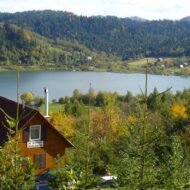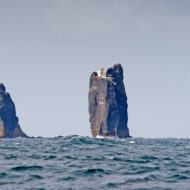


A lighthouse on a sea stack in the North Atlantic, built by men who climbed the rock with chains. A red iron tower above the Arctic Circle. The tallest stone lighthouse in Europe, and two of the oldest working lights in the world. Six lighthouses where Europe meets the sea.
Few buildings are as simple, or as moving, as a lighthouse. A tower, a light, a stretch of dangerous water. For centuries, they marked the edge of the known world for sailors, and the lives of their keepers were among the loneliest in Europe.
Most lighthouses are now automated, and their keepers are gone. But they still stand at the continent’s edges: on Arctic islets, on Atlantic rocks, on salt marshes and on medieval headlands. Some you can climb, some you can sleep in, and some you can only see from a boat or a helicopter.
This article is the starting point of our Lighthouses of Europe series: six lighthouses, each with its own full article.
| Lighthouse | Country | Why go | |
|---|---|---|---|
| 1 | Þrídrangaviti | Iceland | Often called the most isolated lighthouse in the world |
| 2 | Landegode | Norway | A red iron tower above the Arctic Circle, where you can stay the night |
| 3 | Westerheversand | Germany | The classic lighthouse of the North Sea salt marshes |
| 4 | Île Vierge | France | The tallest stone lighthouse in Europe |
| 5 | Kõpu | Estonia | Lit since 1531, one of the oldest working lighthouses in the world |
| 6 | Hook Head | Ireland | Around 800 years old, the oldest intact working lighthouse |
1. Þrídrangaviti, Iceland
63.49° N, 20.51° W · Vestmannaeyjar (Westman Islands)
About 7 km off Heimaey, in the Westman Islands, three rock pillars rise out of the North Atlantic. Their name, Þrídrangar, means “three rock pillars”. On top of the tallest, Stóridrangur, about 36.5 metres above the sea, stands a tiny white house with a light: Þrídrangaviti, often described as one of the most isolated lighthouses in the world.
It was built in 1938 and 1939, by hand, before helicopters. The engineer Árni Þórarinsson recruited climbers from the Westman Islands, men who had always gathered seabird eggs from the cliffs, to scale the rock and fix chains for the builders. Waves often made it impossible to land, and the crew finally camped on the rock to finish the work. A helipad was added later, and since 1993 the light has run on solar power.
→ Read more: Þrídrangaviti Lighthouse
In the Field Guide: the best boat trips and viewpoints from Heimaey, and the Westman Islands beyond the lighthouse.
Visit: the lighthouse is not open to the public and can only be reached by helicopter. See it from boat tours around the Westman Islands, or from the air.
Weather at Þrídrangaviti: wild and oceanic. The Westman Islands are among the windiest places in Iceland, with frequent storms and rough seas, mild winters by Icelandic standards and cool summers. Boat trips depend entirely on the sea.
2. Landegode, Norway
67.45° N, 14.38° E · Eggløysa, near Bodø, Nordland
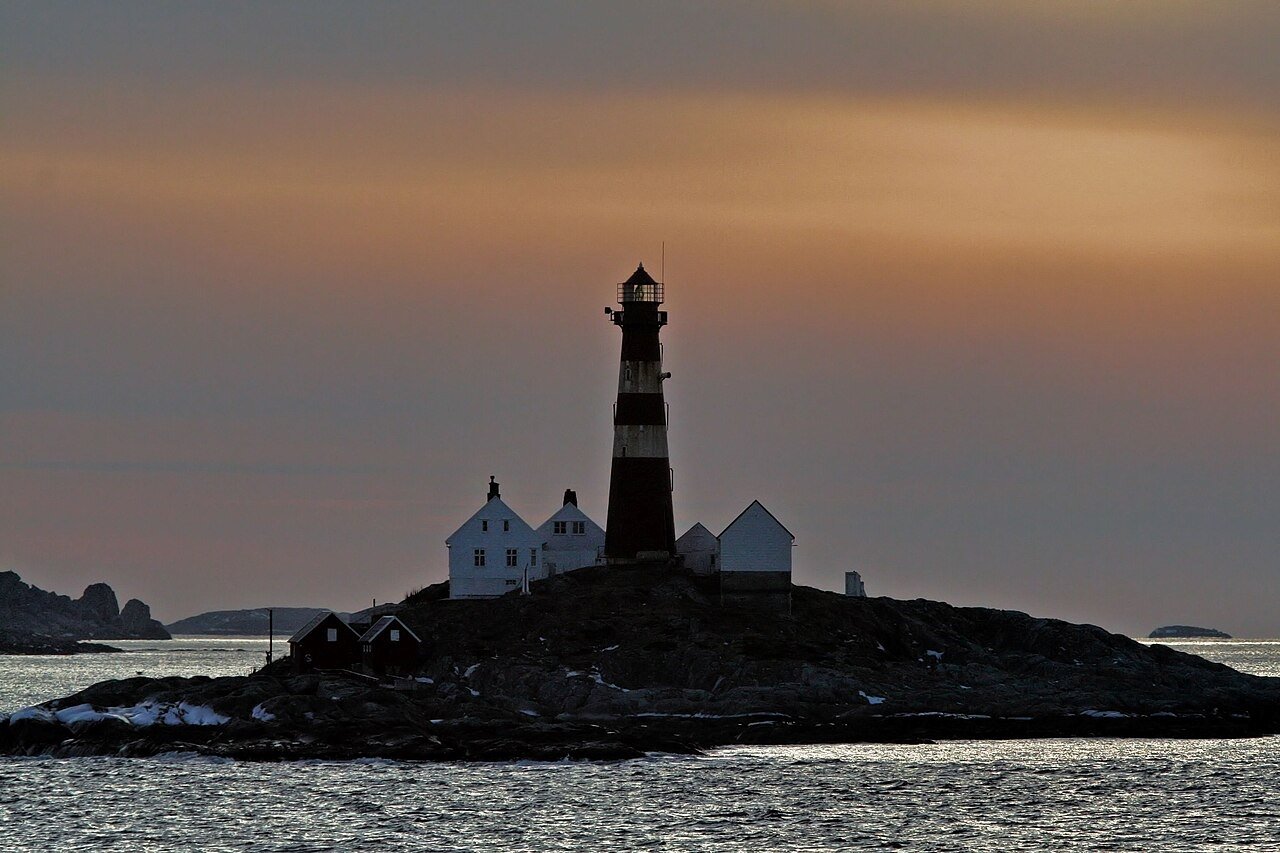
North of the Arctic Circle, on the little island of Eggløysa just north of Landegode, a tall red cast-iron tower with white bands has guarded the sea route into Bodø since 1902. Landegode Lighthouse is 29 metres high, and it was built tall because the island it stands on is low.
It was automated in the late 1980s and is now a protected monument, along with the keepers’ houses, the boathouses and the outbuildings. The Hurtigruten coastal ships pass it as they head north from Bodø, and the old keepers’ houses can be rented for overnight stays, under the midnight sun in summer or the northern lights in winter.
→ Read more: Landegode Lighthouse
In the Field Guide: getting there by boat from Bodø, staying in the keepers’ houses, and the northern lights season.
Visit: by boat from Bodø, about 18 km to the south.
Weather at Landegode: a sub-Arctic coastal climate, milder than its latitude suggests thanks to the Gulf Stream. Summers are cool with the midnight sun; winters are dark, windy and snowy, with the northern lights from autumn to spring.
3. Westerheversand, Germany
54.37° N, 8.64° E · Westerhever, Eiderstedt peninsula, Schleswig-Holstein
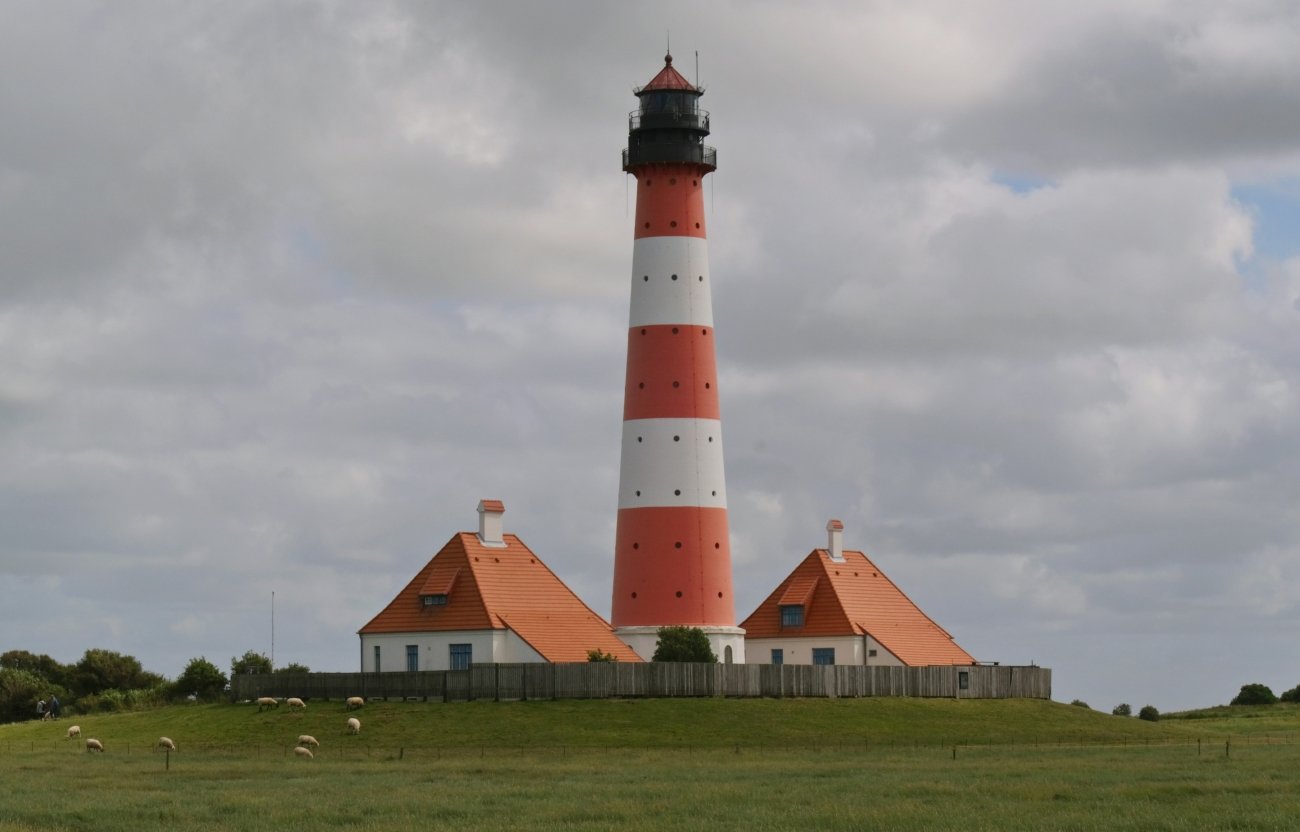
On the North Sea coast of Schleswig-Holstein, a red and white tower rises from a mound in the middle of the salt marshes. Westerheversand Lighthouse is the landmark of the Eiderstedt peninsula, and probably the most famous lighthouse in Germany.
Built in 1906–07 and in service since 1908, the tower is about 40 metres high. It stands at the edge of the Wadden Sea, a UNESCO World Heritage Site, where the tide uncovers mudflats that stretch to the horizon.
→ Read more: Westerheversand Lighthouse
In the Field Guide: the walk across the salt marsh, tower visits, mudflat hikes, and the best light for photographs.
Visit: on foot across the salt marsh from the car park at Westerhever.
Weather at Westerheversand: a breezy North Sea climate: mild summers, grey and windy winters, and fast-changing skies. There is no shelter on the marsh, so bring a windproof layer in every season.
4. Île Vierge, France
48.64° N, 4.57° W · Plouguerneau, Finistère, Brittany
Off the north coast of Finistère, on a small island 1.5 km from the shore, stands a granite giant. Built between 1897 and 1902, the Île Vierge lighthouse is 82.5 metres high: the tallest stone lighthouse in Europe and, according to Guinness World Records, the tallest traditional lighthouse in the world.
Inside, a staircase of nearly 400 steps spirals up past walls lined with thousands of opaline glass tiles. Beside it stands the island’s first lighthouse, from 1845, which suddenly looks tiny.
→ Read more: Île Vierge Lighthouse
In the Field Guide: boat crossings and climbing days, and the other great lighthouses of the Iroise Sea.
Visit: by boat from the coast near Plouguerneau, on special visit days in summer.
Weather at Île Vierge: a mild, oceanic Breton climate: cool summers, mild winters, and frequent wind, rain and fog. Crossings can be cancelled in rough seas.
5. Kõpu, Estonia
58.92° N, 22.20° E · Hiiumaa island
In the middle of the forested Kõpu peninsula, on the highest hill of the Estonian island of Hiiumaa, stands a massive white stone tower that looks more like a temple than a lighthouse. The Kõpu Lighthouse was completed in 1531, and it has been in use ever since, making it one of the oldest continuously working lighthouses in the world, and the oldest on the Baltic Sea.
It warns ships away from the Hiiu shoals, dangerous limestone shallows to the north-west that have claimed many ships. The tower is about 38 metres high, but because it stands on a hill, its light shines from about 102 metres above the sea, the highest on the Baltic.
In the Field Guide: climbing Kõpu, the neighbouring Ristna and Tahkuna lighthouses (one ticket covers all three), and Hiiumaa’s coast.
Visit: the tower is open to visitors. Hiiumaa is reached by ferry from Rohuküla to Heltermaa, on the mainland.
Weather at Kõpu: a cool Baltic climate: mild, light summers, and cold, dark, snowy winters. The open coast is often windy.
Full article coming soon.
6. Hook Head, Ireland
52.12° N, 6.93° W · Hook Peninsula, County Wexford
At the tip of the Hook Peninsula, guarding the entrance to Waterford Harbour, stands a sturdy medieval tower. Hook Lighthouse was built around 1210–1230 by William Marshal, the Norman knight known as “the greatest knight”. Around 800 years later, it is still working, and it is described as the oldest intact operational lighthouse in the world.
Inside the thick medieval walls, guided tours climb 115 steps to the balcony, with views over the sea, where whales and dolphins are sometimes seen.
In the Field Guide: the tour, the Hook Peninsula’s cliffs and fossils, and the coast of Ireland’s Ancient East.
Visit: guided tours all year, from the visitor centre in the old keepers’ houses.
Weather at Hook Head: a mild, damp Atlantic climate with frequent wind and rain; winters are mild and summers cool. The headland is very exposed.
Full article coming soon.
Beyond the map
Lighthouses were built to be seen, but rarely to be visited. They stand where the land ends: on rocks, islands and headlands that most travellers never reach. Every one of them is a reason to go a little further, to the edge of the map.
Lighthouses of Europe — a Beyond the Map Field Guide
[Lighthouses of Europe — The Beyond the Map Field Guide] (product link to add) · [PRICE]
Our guide to Europe’s most remarkable lighthouses:
- The six lighthouses in detail, with visiting days, boat crossings and access
- Lighthouses you can climb, and lighthouses you can sleep in
- More remote and historic lights: Cordouan, Ar-Men, Fastnet, Lindesnes and others
- The best viewpoints and boat trips for lighthouses closed to the public
- Seasonal tips: midnight sun, northern lights and winter storms
- Offline maps and GPS points
→ [Get the Field Guide]
Read next: Þrídrangaviti Lighthouse · Westerheversand Lighthouse · Landegode Lighthouse · Île Vierge Lighthouse
Explore more: Europe’s Forgotten Harbours (update with published URL) · Europe’s Most Beautiful, Beyond the Map