

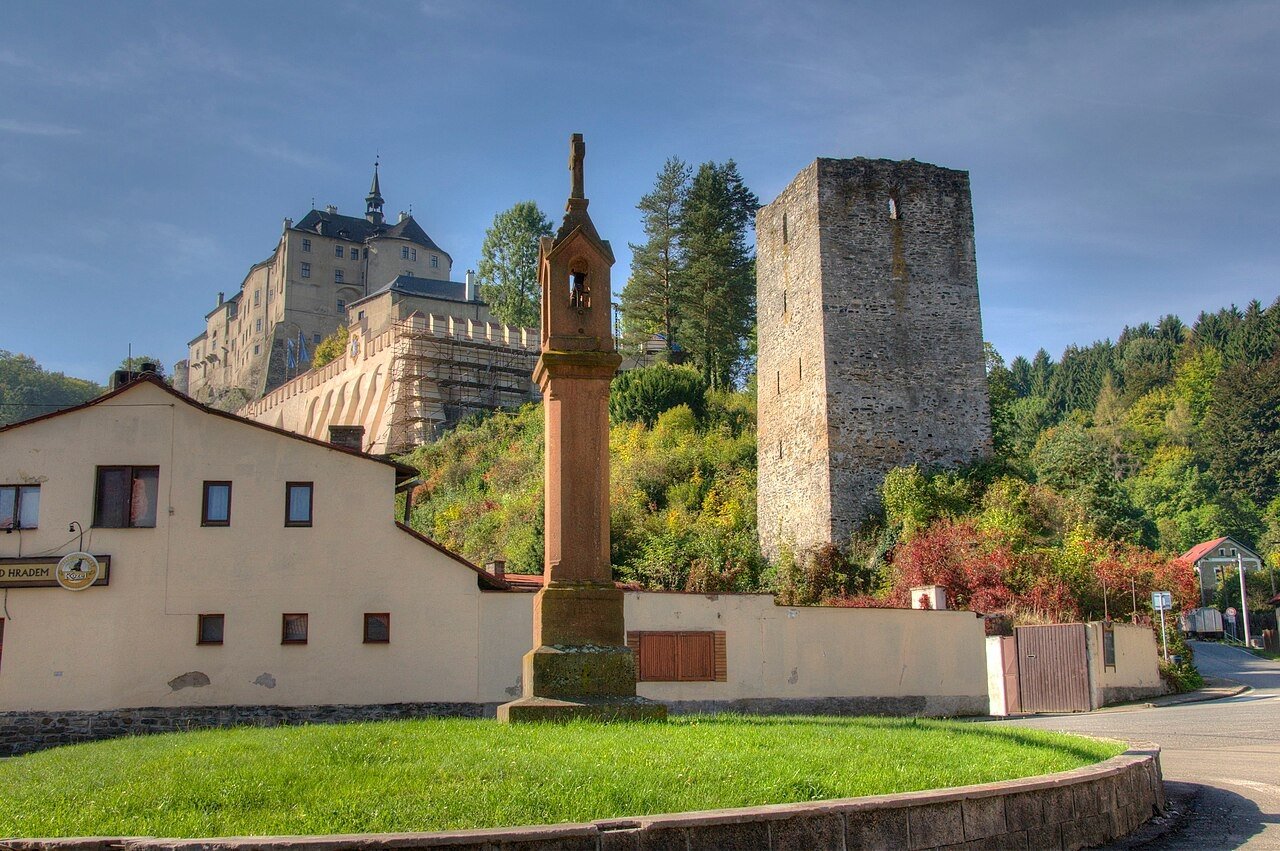
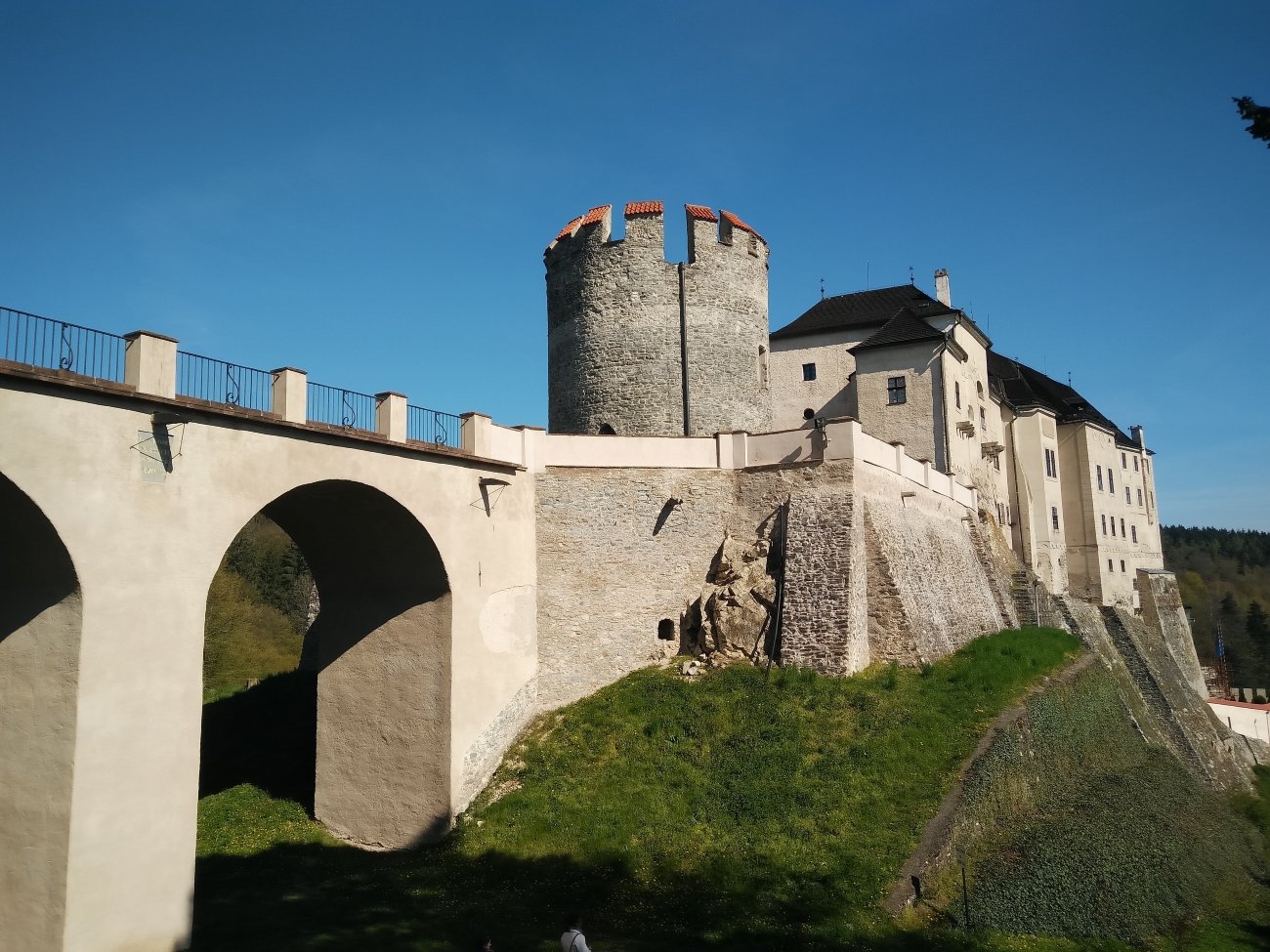
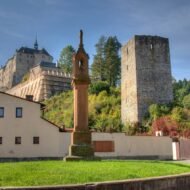
On a granite ridge above a bend of the Sázava, a Gothic castle has watched the same river for nearly eight centuries. The family who built it in 1241 still owns it. Few castles in Europe can say the same.
Most of the great castles of Bohemia belong to the state today. Their founding families died out, sold up, or lost everything in war and revolution. Český Šternberk is different. It was built by a nobleman who took his name from it, and his descendants, the Sternbergs, still hold it.
From the river below, it looks severe and medieval: a long wall of stone along a rocky ridge, with towers at each end. Inside, it is another world, of Baroque stucco, family portraits and the comfortable rooms of a house that is still lived in.
→ Read more: Bohemia: The Kingdom at the Heart of Europe
At a glance
| Where | Český Šternberk, Central Bohemia, Czech Republic |
| Coordinates | 49.81° N, 14.93° E |
| What | Early Gothic castle with Baroque interiors |
| Founded | Around 1241 |
| Owners | The Sternberg family, founders of the castle |
| Distance from Prague | About 40 km south-east |
| Visit | Guided tour only, about 50 minutes |
| Time needed | Half a day, with lunch by the river |
The star on the mountain
Around 1241, a Bohemian nobleman, Zdeslav of Divišov, built a castle on a steep granite cliff above the river Sázava. His coat of arms was an eight-pointed golden star, and he named the castle after it, in the German fashion of the day: Sternberg, “star mountain”. Šternberk is the Czech spelling. He then took the name himself, and the Sternberg family was born.
The star still appears everywhere in the castle, and the family motto is “The star that never falls”.
The castle was built for war, and it saw it. In the 1460s, its lord joined a revolt of nobles against King George of Poděbrady, and the royal army besieged and took it. When the castle was returned to the family, they added a sharp-pointed artillery bastion to the south, to protect the weakest side. It is still there today.
In the second half of the 17th century, the castle was transformed from fortress to residence. Behind its Gothic walls, the rooms were filled with rich stucco ceilings by the Italian master Carlo Brentano.
Eight centuries, two interruptions
The castle did not stay with the family without a break. It passed out of their hands for a time, and was bought back by a Sternberg in 1841.
The hardest break came after 1948. The Communist regime nationalised the castle in 1949. Its last owner, Jiří Sternberg, stayed on as the castle’s administrator, the caretaker of his own family home, and by carefully listing its contents, he saved much of the original furniture.
After the fall of Communism, the castle was returned to the family in 1992, and Sternbergs still live here today.
What to see
The tour leads through fifteen furnished rooms on the second floor, following the story of the family.
The engravings. On the staircase hang 545 copper engravings from the Theatrum Europaeum, scenes from the Thirty Years’ War. It is said to be one of the largest single-subject print collections in Europe, and easy to walk past without noticing.
The Knights’ Hall. The largest room in the castle, with the richest 17th-century stucco, on the ceiling and walls, and portraits of the commanders of the Thirty Years’ War.
The chapel of St Sebastian. The family chapel, with a painting of the saint by an unknown Dutch master of the early 17th century.
The Yellow Salon and the Pink Boudoir. The castle’s most elegant rooms, with painted walls and fine stucco ceilings.
The family rooms. A family tree on the wall, studies of 20th-century Sternbergs, and the reading chair of Kašpar Sternberg, the naturalist and co-founder of the National Museum in Prague, in 1818.
The bastion. Outside, a separate ticket takes you up the old artillery bastion, known as the Hladomorna (“starvation tower”), for a view along the Sázava valley. It never actually served as a prison.
A legend: a painting in the castle shows Jaroslav of Sternberg, said to have defeated the Mongols at Olomouc in 1241. It is a good story, but no such man lived then. The legend grew from a real defence of Olomouc by another Sternberg a few years later.
When
Best: May to September, ideally on a weekday.
The castle is open daily except Mondays from May to September, with longer hours in July and August. In October, it opens at weekends; from November to April, there are weekend and Advent tours, and weekday visits by arrangement. Check the castle’s website before going.
In summer, the castle hosts the Noir Film Festival, and the river below is popular for swimming, canoeing and cycling.
Weather at Český Šternberk: a Central European climate. In Prague, average highs are about 19°C in May, 24°C in July and August, 20°C in September and 14°C in October; winters are cold, with highs around freezing in January. The valley is often misty on autumn mornings.
Getting there
- By train: the most scenic way. The Posázavský Pacifik line follows the Sázava valley and stops at Český Šternberk zastávka, just below the castle on the opposite bank. From Prague, change at Čerčany.
- By car: about 50 minutes from Prague via the D1 motorway. The castle car park is in the valley; from there, a paved path climbs about 250 metres to the gate.
- Good to know: the tour has about 120 steps to the second floor, with no lift. Dogs are not allowed inside.
Beyond the map
Prague’s day-trippers usually head to Karlštejn or Kutná Hora. Český Šternberk is just as close, and much quieter. It is not a museum built around an empty shell, but a family home that has survived war, sieges, sales and Communism, with the same star still over the door, nearly 800 years later.
Read next: Bohemia: The Kingdom at the Heart of Europe · Hidden Medieval Worlds · Europe’s Forgotten Giants