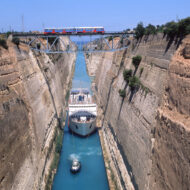



Quick answer: Greece is easy to travel without a car if you plan around three networks. Ferries link the islands, KTEL buses cover the mainland, and domestic flights save long sea crossings. Trains are limited but useful on a few routes. A rental car becomes worth it in the mountains and on larger islands such as Crete.
Greece is a country of distances that look short on the map and turn out long in practice. Mountains divide the mainland, the sea divides the islands, and the timetable changes with the season. Getting around well is less about speed than about understanding how each network works, and choosing the right one for each leg of the journey.
This guide is the starting point. Each section below gives you the essentials and links to our detailed guides.
Ferries: the backbone of Greek travel
More than two hundred Greek islands are inhabited, and most of them can only be reached by sea. The ferry network is the most extensive island system in Europe, run by large operators such as Blue Star Ferries, Seajets and Golden Star, and by many small local lines.
The essentials:
- Main ports from Athens: Piraeus for most of the Cyclades, Crete and the Dodecanese; Rafina for the northern Cyclades and Evia; Lavrio for Kea and Kythnos.
- Book ahead in summer: two to three months for July and August on popular routes.
- Fast vs conventional: fast ferries save hours but cost more and cancel first in strong wind.
- The meltemi: the strong summer north wind can cancel crossings between July and September. Always leave a buffer day before a flight.
Our ferry guides:
- Booking Ferry Tickets in Greece: booking sites, prices, ports and what to do if a ferry is cancelled
- Island Hopping Greece: Six Island Territories Beyond the Obvious: how the six island groups and their ferry networks work
- The Cyclades: A Complete Ferry Route
- Ancient Greece by Sea: The Island Hopping Guide
- Athens Airport to Piraeus Port: from landing to boarding
KTEL buses: the mainland network
For most of mainland Greece, the bus is the real public transport. KTEL is a network of regional bus companies that connects almost every town, and many villages, to its regional capital and to Athens.
- From Athens: most mainland routes leave from the Kifissos bus terminal; some routes to central Greece leave from the Liosion terminal. Check which one before you go.
- Tickets: buy at the station or on board; many regional KTEL companies also sell online.
- Timetables: each regional KTEL publishes its own. Village services are often limited to one or two buses a day, or only on school days.
Buses are reliable, inexpensive and the best way to reach places like Delphi, Nafplio or the Peloponnese without a car.
Trains: limited but useful
Greece’s rail network is small. The main line runs from Athens to Thessaloniki, and the Athens suburban railway links the airport with the city and the north-eastern Peloponnese.
Trains are worth it for:
- Athens to Thessaloniki, a comfortable alternative to the bus or a flight
- Meteora, by train to Kalambaka, the town at the foot of the monasteries
- The Diakopto–Kalavryta rack railway, one of the most beautiful short train journeys in Europe, through the Vouraikos Gorge
For most other routes, the bus is faster and more frequent.
Domestic flights
Domestic flights are the fastest way to cover long distances, such as Athens to Crete, Rhodes or the islands of the Northern Aegean. They often cost little more than a fast ferry and save a full day of travel.
They make the most sense for one-way legs: fly out to a distant island, then come back slowly by ferry through the islands in between.
Getting around Athens
Athens has a clean, simple metro with three lines. Line 3 links the airport with Syntagma and runs all the way to the port of Piraeus. Buses, trams and the suburban railway fill the gaps.
Coming soon: Athens Metro Guide
Renting a car
A car is not necessary for a classic island-hopping trip, but it changes everything in some places:
- The mountains: Zagori, the Pindus, the inner Peloponnese
- Large islands: Crete, Evia, Kefalonia, Lesbos
- Remote coasts: where buses run once a day or not at all
Driving in Greece is straightforward outside Athens. Mountain roads are slow, so plan for fewer kilometres per day than the map suggests.
Coming soon: Renting a Car in Greece
Getting around Greece without a car
Most of Greece is reachable without driving. A typical car-free route combines a ferry to the islands, local buses or a scooter on each island, and KTEL buses and trains on the mainland. The only places where it becomes genuinely difficult are the high mountain villages and the most remote coasts.
Coming soon: Exploring the Peloponnese Without a Car · Getting to the Zagori Villages · Getting Around Epirus and the Ionian Coast · Small Cyclades Without a Car
Beyond the map: where the networks end
The best of Greece often lies at the very end of a route: the last stop of a ferry, or the village where the bus turns round. Islands like Anafi, Tilos and Ithaca reward the extra crossing. On the mainland, places like Monemvasia are worth the slow bus ride.
Before you go
- Mobile data: an eSIM is the simplest way to stay connected on ferries and in rural areas.
- Travel insurance: check that it covers missed connections and ferry cancellations.
- Schengen rules: Greece is in the Schengen Area. If you’re not an EU citizen, check your remaining days with our Schengen Visa Calculator.
Europe Transport Guide
This page is part of the Europe Transport Guide: practical guides to travelling slowly, and mostly without a car, through the Europe most visitors never reach.
Explore more: How You Travel · Island Hunter · Field Guides