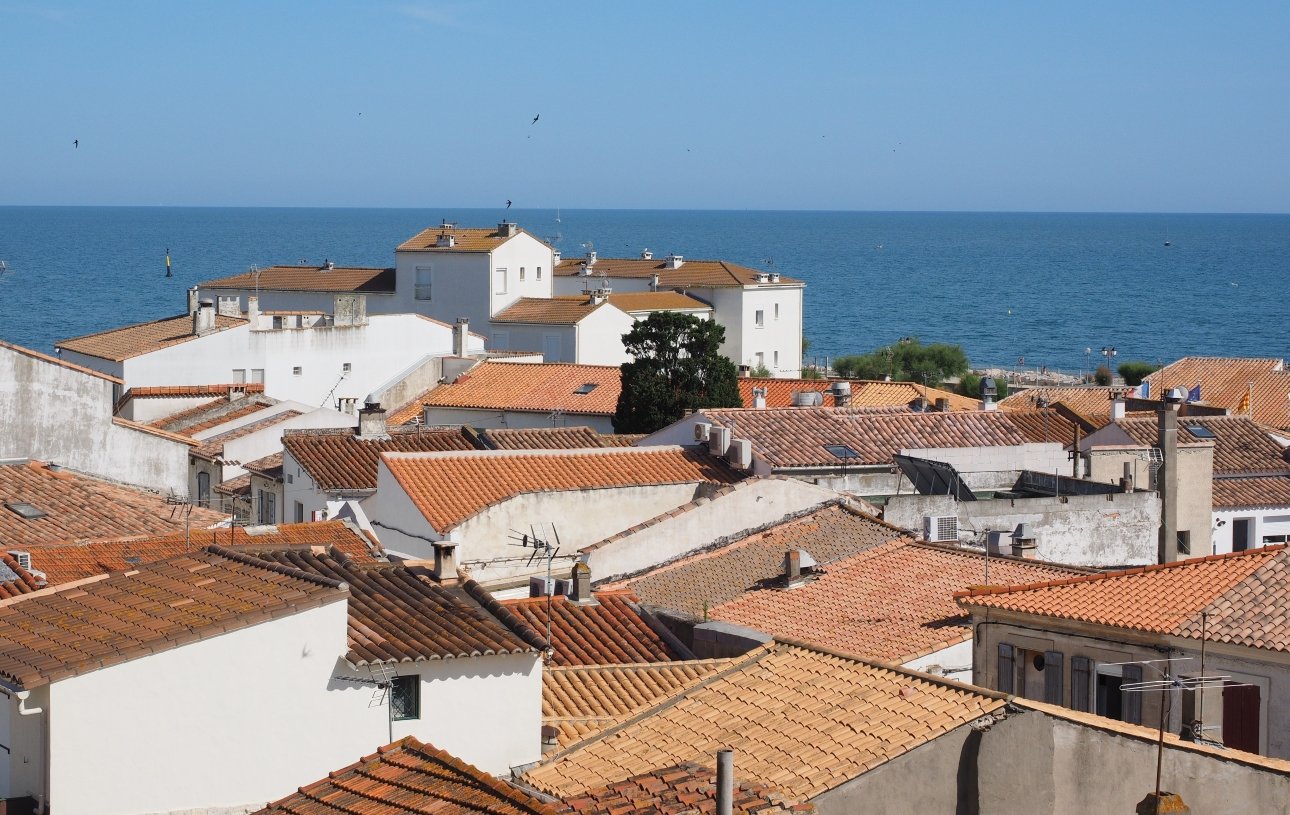


Saintes-Maries-de-la-Mer is the most extraordinary small town in the Camargue and the most extraordinary pilgrimage destination in southern France — a fortified church town on the Mediterranean coast of the Rhône delta that has been simultaneously a place of Christian pilgrimage, Roma spiritual capital and Camargue cowboy ceremonial centre for centuries, a combination of cultural identities so completely unlike any other small town in France that no single editorial register adequately describes it.
The town has 2,500 permanent inhabitants. In May it receives the most extraordinary gathering in southern France — the Roma pilgrimage of Saintes-Maries, when tens of thousands of Roma from across Europe arrive to honour the Black Sarah, their patron saint, whose statue is carried from the crypt of the extraordinary Romanesque church to the sea in a procession of extraordinary emotional power. In the same month the Fête des Gardians fills the streets with hundreds of Gardians on white Camargue horses escorting the statue of the saints through the town in a completely separate but simultaneous celebration. The extraordinary beach extends for kilometres in both directions. The flamingos are visible on the salt flats to the north. The bulls are in the marshes to the east.
Saintes-Maries is not a resort. It is a living community of extraordinary cultural complexity that happens to have an extraordinary beach.
The church — the fortress of faith
The Church of Notre-Dame-de-la-Mer is the most extraordinary single building in the Camargue — a Romanesque fortress church of the 9th to 12th centuries built on the highest ground in the extraordinary flat delta landscape, its exterior walls incorporating defensive machicoulis and a battlemented roofline designed for defence against Saracen raids as much as for worship. The church was genuinely used as a fortress — the population of the town sheltered within its walls during the most dangerous centuries of the medieval period, the extraordinary nave serving as both sacred and defensive space simultaneously.
The interior is extraordinary in its severity — the extraordinary Romanesque nave of extraordinary simplicity, the extraordinary painted wooden statues of the Maries (Mary Magdalene and Mary of Bethany, the biblical figures the town commemorates), the extraordinary boat carved from wood hanging from the ceiling above the nave — the barque that the legend holds carried the Maries and the Black Sarah from Palestine to this shore after the Resurrection.
The crypt is the most extraordinary space — the small underground chamber below the altar where the statue of the Black Sarah is kept throughout the year, surrounded by the extraordinary accumulation of votive offerings, photographs, flowers and the extraordinary embroidered capes donated by Roma visitors from across Europe. The Black Sarah is not a canonical Christian saint — she is the patron saint of the Roma people, incorporated into the Saintes-Maries tradition from a parallel Roma spiritual tradition of uncertain origin but extraordinary emotional force. The crypt during the pilgrimage — the candles, the singing, the extraordinary emotional intensity of thousands of Roma worshippers in a space designed for dozens — is one of the most extraordinary religious experiences in France.
Visiting:
Church of Notre-Dame-de-la-Mer
Open daily year-round
Rooftop terrace: April-September (extraordinary views
across the flat Camargue landscape)
Crypt: accessible year-round
Free entry · donations welcomed
The Roma pilgrimage — 24-25 May
The Pèlerinage des Gitans — the Roma Pilgrimage — is the most extraordinary annual gathering in southern France and one of the most extraordinary religious events in Europe. Roma communities from Spain, Portugal, France, Italy, Romania, Hungary and beyond arrive in Saintes-Maries on 24-25 May each year for the procession of the Black Sarah to the sea.
The procession on 24 May — the eve of the main celebration — carries the statue of the Black Sarah from the crypt through the town to the beach, where the Gardians on white horses escort her to the waterline and the sea is blessed in a ceremony of extraordinary visual drama. The beach at this moment — the Roma crowds, the white horses in the shallow water, the extraordinary flat Mediterranean horizon, the extraordinary Mediterranean light of late May — is one of the most extraordinary scenes in southern France.
The procession on 25 May carries the statues of the Two Maries from the church to the sea in a separate ceremony of comparable emotional power, again escorted by the Gardians on horseback.
The pilgrimage is not a tourist event. Visitors are welcome but the ceremony belongs to the Roma community — understanding this distinction is the editorial and ethical condition of attending. The extraordinary music, the extraordinary costume, the extraordinary emotional intensity of the gathering are not performances for visitors but expressions of a living spiritual tradition of extraordinary depth.
The Fête des Gardians — 1 May
The Fête des Gardians — the Festival of the Gardians — on 1 May is the most extraordinary celebration of the living Camargue cowboy culture, held annually in Saintes-Maries as the ceremonial capital of the Gardian world. Hundreds of Gardians ride into the town on white Camargue horses in the most extraordinary display of the living tradition — the extraordinary traditional costume of the Gardian, the extraordinary skill of the horsemen in the narrow streets, the extraordinary spectacle of the white horse herds moving through the extraordinary flat Camargue landscape on the approach to the town.
The Fête des Gardians and the Roma pilgrimage three weeks later make May the most extraordinary month in Saintes-Maries and the most rewarding for visitors who want to understand the Camargue as a living cultural territory rather than a wildlife destination.
The beach
The Plage de Saintes-Maries extends east and west along the extraordinary flat Mediterranean coastline of the Camargue with an extraordinary quality of wild coastal openness that the developed Côte d’Azur cannot replicate. The beach is wide, the sand is fine, the water is extraordinarily clear in the sections away from the river outflows and the extraordinary flat horizon gives the Mediterranean here a character of remarkable spaciousness — the sea visible from the beach as a genuinely open expanse rather than a crowded cove.
The western beach — the Plage de l’Espiguette — extends 5km toward Port-Camargue in complete undevelopment, the dune system behind the beach the most completely natural coastal dune landscape remaining on the French Mediterranean coast. The most extraordinary beach walk in Provence.
The bulls — Course Camarguaise
The Course Camarguaise — the Camargue bullfighting tradition — is completely different from the Spanish corrida. No animal is killed. The raseteurs — the athletes of the Course Camarguaise — compete to remove ribbons and strings tied between the horns of the bull using a small hooked comb, earning points for each successful removal in the extraordinary circular arena while the bull pursues them across the sand. The bulls used are the Camargue breed — the extraordinary black semi-wild cattle managed by the Gardians — and the same bull appears multiple times across a season, its intelligence and speed improving with each appearance until the most experienced bulls become the most celebrated participants in the tradition.
The Course Camarguaise arena in Saintes-Maries hosts events throughout the summer season — the most extraordinary and most authentically Provençal sporting tradition in southern France, connecting the Roman amphitheatre culture of Arles to the Gardian cattle-herding culture of the Camargue in one extraordinary living institution.
Practical information
Location:    50km south of Arles · 40km from Aigues-Mortes
             · 120km from Marseille

Getting there:
By bus:      Line 20 from Arles — twice daily
             1 hour journey · limited Sunday service
By car:      The recommended approach — D570 from Arles
             through the extraordinary flat Camargue
             landscape (40 minutes)
By bicycle:  From Aigues-Mortes via the extraordinary
             coastal cycle path — 20km · extraordinary
             flat terrain · 1.5 hours

Best seasons:
May          Roma pilgrimage · Fête des Gardians
             Most extraordinary cultural month
April-June   Flamingo breeding on nearby étangs
             Wildflower salt marsh
July-August  Extraordinary beach · full summer season
             Course Camarguaise programme
September    Extraordinary light · bird migration
             · quieter than summer

Accommodation: Book far in advance for May pilgrimage week
               — the town fills completely 3-4 days before
               the procession
Saintes-Maries-de-la-Mer is part of The Wanders Camargue regional guide — the complete Beyond the Map editorial series on the extraordinary wild coastal territory of the Rhône delta.