

A toy-making village where the whole main street becomes a Christmas market. A copper-mining town of wooden houses under deep Norwegian snow. Carollers going from farm to farm in the wooden villages of Maramureș. Five small mountain places where Christmas still feels like it used to.
Big-city Christmas markets are bright, busy and wonderful for an evening. But the Christmas many of us remember, or imagine, is quieter: snow on the roofs, wood smoke, a candle in every window, a carol sung in a church that has stood for centuries, and somewhere warm to come back to.
That Christmas still exists, in the mountains of Europe, in places that are small enough to walk across in ten minutes and far enough from the main roads to keep their own traditions. Here are five of them, with their 2026 dates.
| Place | Country | Why go at Christmas | |
|---|---|---|---|
| 1 | Seiffen | Germany | The toy village of the Ore Mountains, with a month-long Christmas and a miners’ parade |
| 2 | Røros | Norway | A UNESCO mining town of wooden houses and a Christmas market in the snow |
| 3 | Maramureș | Romania | Carols, wooden churches and village Christmas customs that never stopped |
| 4 | Glurns | Italy (South Tyrol) | The smallest town in the Alps, with an Advent market inside its medieval walls |
| 5 | Val d’Aran | Spain | Christmas concerts in Romanesque churches in a Pyrenean valley |
1. Seiffen, Germany
50.65° N, 13.45° E · Erzgebirge (Ore Mountains), Saxony
If you have ever seen a wooden nutcracker, a smoking incense man (Räuchermann), a candle arch (Schwibbogen) or a Christmas pyramid, there is a good chance it came from the Erzgebirge, and quite possibly from Seiffen. When the old silver and tin mines of the Ore Mountains declined, the miners turned to wood-carving, and Seiffen became the centre of a toy-making tradition that still fills workshops along its main street.
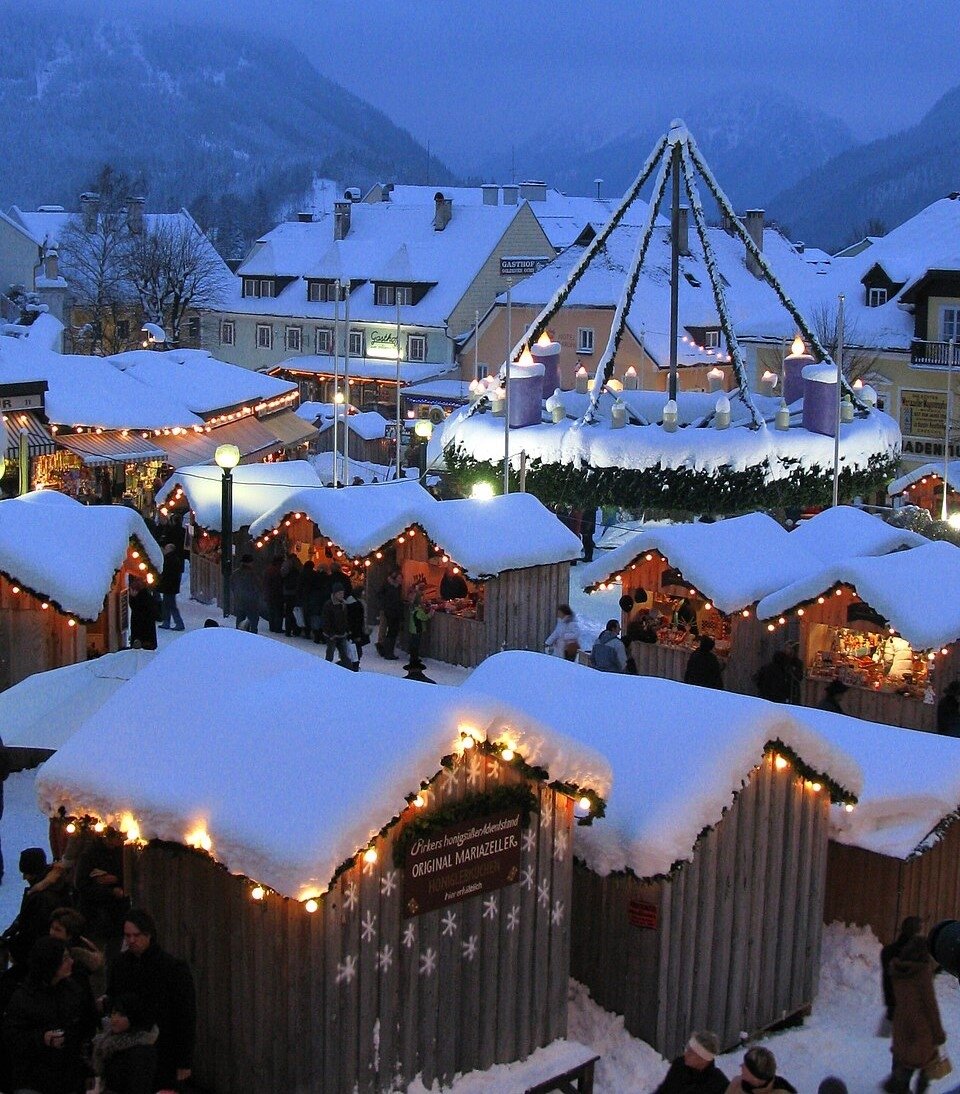
At Christmas, the whole village becomes the market. The Seiffener Weihnacht runs from 27 November to 22 December 2026, with free entry, and on 12 December 2026, more than 400 people in miners’ uniforms march through the village in the Great Miners’ Parade (Große Bergparade), from 15:30.
In the Field Guide: the toy museum and workshops, the nutcracker village of Neuhausen nearby, and the Christmas markets of Annaberg-Buchholz and the Erzgebirge.
2026 dates: Seiffener Weihnacht, 27 November – 22 December, Great Miners’ Parade, 12 December.
Weather in Seiffen: a cold mountain climate at around 600 metres. December days are usually close to freezing, nights are colder, and snow is common, though not guaranteed.
Getting there: in the Ore Mountains near the Czech border; about an hour by car from Dresden or Chemnitz.
2. Røros, Norway
62.57° N, 11.38° E · Trøndelag
High on a plateau near the Swedish border, Røros grew up around a copper mine from the 17th century. Its streets of low, coloured wooden houses, its smelting works and the white slag heaps around the town are now a UNESCO World Heritage Site, and in winter, under deep snow and blue twilight, it looks like a Christmas card.
The town is best known for its great winter fair in February, Rørosmartnan. But since 2009, Røros has also held a Christmas market in the historic centre, with local food (try the famous Røros butter), crafts, horse-drawn sleighs, reindeer, and a Christmas concert in Røros church. In 2026, it runs from 3 to 6 December.
In the Field Guide: the Christmas market, sleigh rides, Røros church, the old mine at Olavsgruva, and where to stay in the historic centre.
2026 dates: Røros Christmas market, 3–6 December.
Weather in Røros: cold, dry and snowy, at around 600 metres. December temperatures are well below freezing, and daylight lasts only a few hours.
Getting there: by train or flight from Oslo or Trondheim; extra flights have been added from Oslo on Christmas-market weekends.
3. Maramureș, Romania
47.73° N, 23.99° E · Northern Romania (Breb, Botiza, Ieud, Sighetu Marmației)
In the hills of northern Romania, near the Ukrainian border, Maramureș is one of the few corners of Europe where Christmas has never become a show. Its villages, with their carved wooden gates, wooden houses and UNESCO-listed wooden churches, keep customs that are still lived rather than performed.
The season begins on 20 December, St Ignatius’ Day, when families traditionally slaughter the pig for the Christmas table. On Christmas Eve, children and then young men go from house to house singing colinde, the old Romanian carols, and the celebrations run on through the New Year. In Sighetu Marmației, the Winter Customs and Traditions Festival, held for more than half a century, fills the town with carollers, masks, drums and bells, usually around 27 December.
In the Field Guide: Christmas guesthouse stays in Breb and Botiza, the wooden churches of Ieud and Bârsana, the Sighet festival, and how to join village customs respectfully.
2026 dates: Christmas Eve carolling, 24 December, Sighet Winter Customs Festival, usually around 27 December (check the date).
Weather in Maramureș: a cold continental climate. December days are often around freezing, nights colder, and the hills are usually under snow by Christmas.
Getting there: fly to Baia Mare or Cluj-Napoca, then drive north many village guesthouses offer Christmas packages.
4. Glurns, Italy
46.67° N, 10.55° E · Vinschgau (Val Venosta), South Tyrol
In the upper Vinschgau valley, close to the Swiss border, Glurns (Glorenza in Italian) is completely surrounded by its 16th-century walls, with three gate towers and a little arcaded street. With just under 1,000 inhabitants, it is the smallest town in South Tyrol and is often called the smallest in the Alps.
For a few days in early December, the Glurnser Advent fills the arcades and squares with around 45 stalls, under the motto “Lights, Scents, Sounds”: brass bands, choirs, a Christmas play by the local theatre group, crafts and local food. It is small, quiet and very far from the crowds of the big South Tyrol markets.
In the Field Guide: the Advent market, the walls and towers, Marienberg Abbey above Burgeis, and the Christmas markets of Merano.
2026 dates: usually the weekend around 8 December (in 2025, 5–8 December) check the 2026 dates.
Weather in Glurns: an Alpine valley climate at about 900 metres: dry and sunny, but cold in December, often below freezing at night, with snow on the surrounding peaks.
Getting there: by train along the Vinschgau line from Merano to Mals or Schluderns, then a short bus ride; about 1.5 hours by car from Merano.
5. Val d’Aran, Spain
42.70° N, 0.85° E · Central Pyrenees, Catalonia
In the high Pyrenees, the Val d’Aran faces north, towards France, and has its own language, Aranese Occitan. Its villages of grey stone and slate, among them Arties, gather around small Romanesque churches, and at Christmas these become concert halls.
The Christmas season usually begins in early December, when the lights are switched on in Arties and Vielha. Over the holidays, the Romanic Musicau de Nadau brings chamber concerts into the churches of Arties, Vielha, Bossòst and Salardú. The village of Les has revived an old Christmas-log tradition, the Soca de Nadau. And for those who come to ski, Baqueira Beret is just up the valley.
→ Read more: Arties, Val d’Aran
In the Field Guide: the Christmas concerts, the Romanesque churches, Les and the Soca de Nadau, and Arties as a base.
2026 dates: the 2026 programme is usually published in December, check visitvaldaran.com.
Weather in Val d’Aran: a cold mountain climate with Atlantic influence: snowy winters, with days around freezing in the villages and much colder at the ski resort.
Getting there: through the Vielha tunnel from Lleida, about 2.5 hours by car, or from Toulouse in France.
Beyond the map
Christmas is easy to find in Europe’s cities. It is harder to find in its original form: in a carved wooden toy, a carol sung door to door, a candle in an old church, a market small enough to know the stallholders. These five places still have it. They are small, they are cold, and they are worth the journey.
Read next: Advent Beyond Vienna · A Norse Yule · Arties, Val d’Aran