

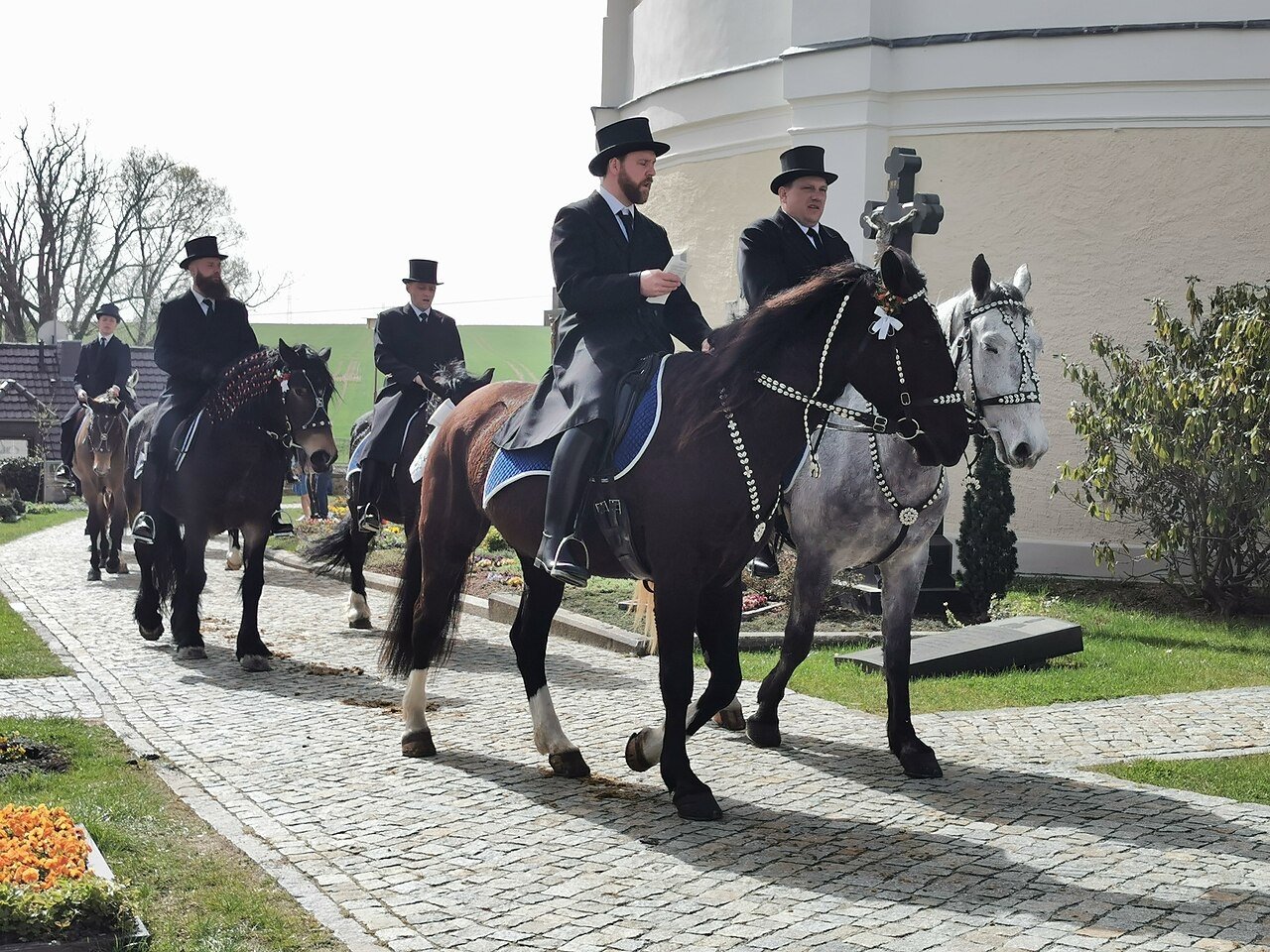
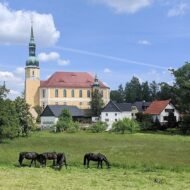
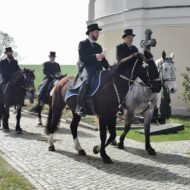
On Easter Sunday morning, the bells of a small Baroque church in eastern Saxony ring out over the fields, and a long line of riders leaves the churchyard: the Easter Riders of Crostwitz. The men wear black tailcoats, top hats and white gloves. Their horses are dressed in embroidered harnesses and ribbons. At the front, riders carry a cross, church banners and a statue of the risen Christ. As the procession moves out across the countryside, the riders sing, but not in German. They sing in Sorbian, a Slavic language that has been spoken here for more than fourteen centuries.
- At a glance
- A Slavic island in Germany
- The village
- The Easter Riders of Crostwitz
- The year in Crostwitz
- St. Marienstern Abbey
- Visiting on Easter Sunday
- Getting there
- Where to stay
- Nearby
- Frequently asked questions
- Beyond the map
- Part of the Civilisation Trails
- Carry the journey with you: Beyond the Map Field Guides
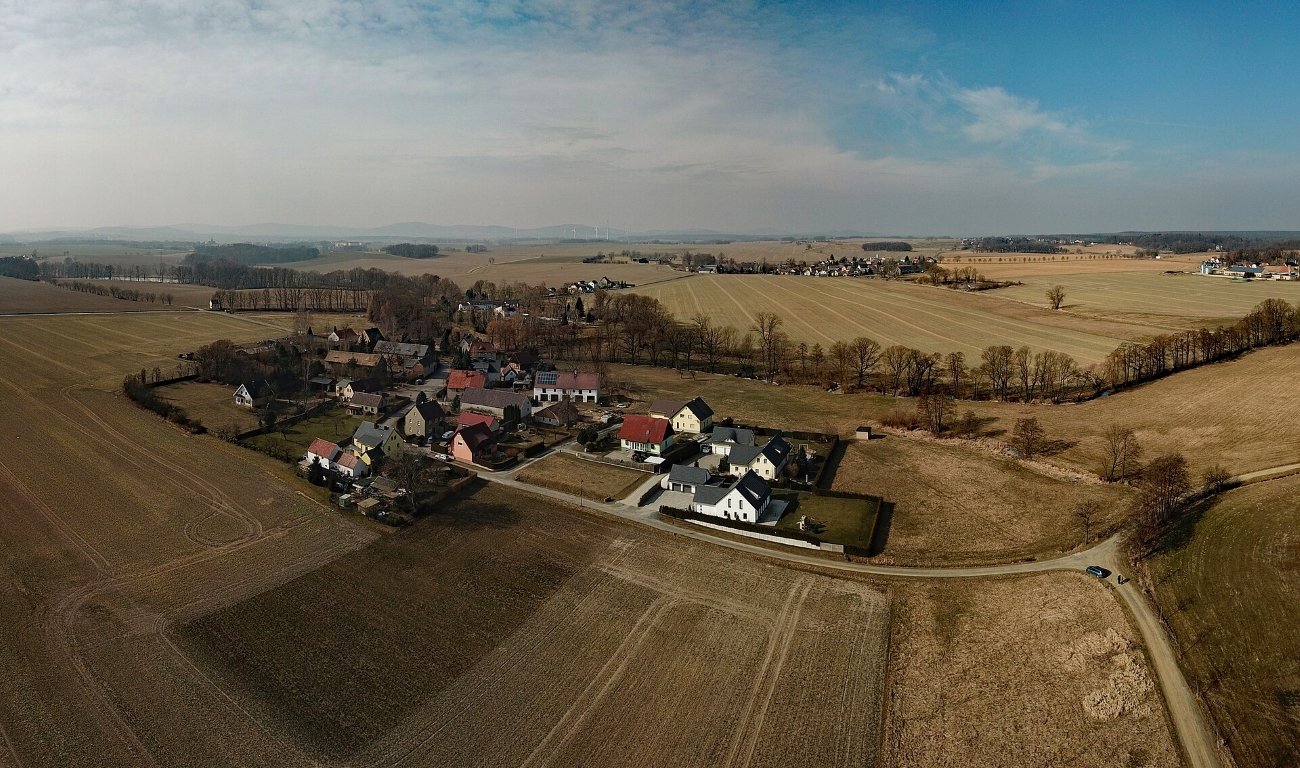
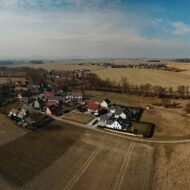
This is Crostwitz, or Chrósćicy, a village of around 600 people at the heart of one of Europe’s least-known cultures. It is the best place to understand the Sorbs: a West Slavic people who have kept their language, faith and customs alive in the middle of Germany.
At a glance
| Where | Upper Lusatia, eastern Saxony, between Kamenz and Bautzen |
| People | Sorbs (Serbja), a West Slavic minority of around 60,000 |
| Language | Upper Sorbian, still the everyday language of the village |
| Known for | The Easter Riders (Křižerjo), Sorbian Catholic traditions |
| Best time | Easter Sunday; late January for the Birds’ Wedding |
| Nearest towns | Kamenz and Bautzen |
A Slavic island in Germany
When Slavic tribes settled the land between the Elbe and the Oder in the 6th and 7th centuries, the ancestors of the Sorbs were among them. Over the following centuries most of these western Slavs were absorbed into the German-speaking world. The Sorbs of Lusatia were the exception. Their language survived the Middle Ages, the Reformation, two world wars, the Nazi ban on Sorbian culture and four decades of East German industrialisation.
It survived best in one small area: the Catholic villages between Kamenz, Bautzen and Hoyerswerda. Here the church, the language and village life held each other together. Crostwitz sits at the centre of this Sorbian Catholic heartland. In 2001, more than 85 percent of its people spoke Sorbian, and today you still hear it in the shop, after mass and on the village street. Road signs, the school and the parish all work in two languages.
The village
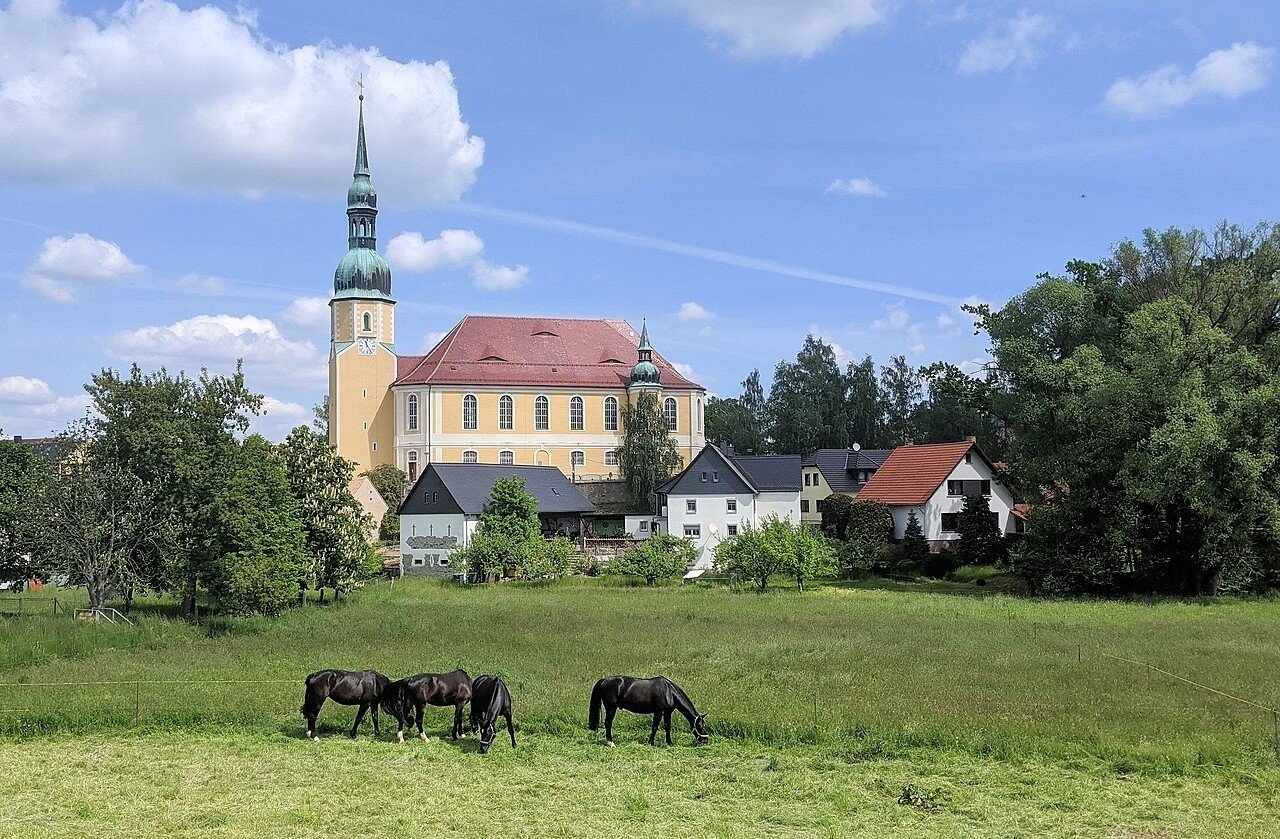
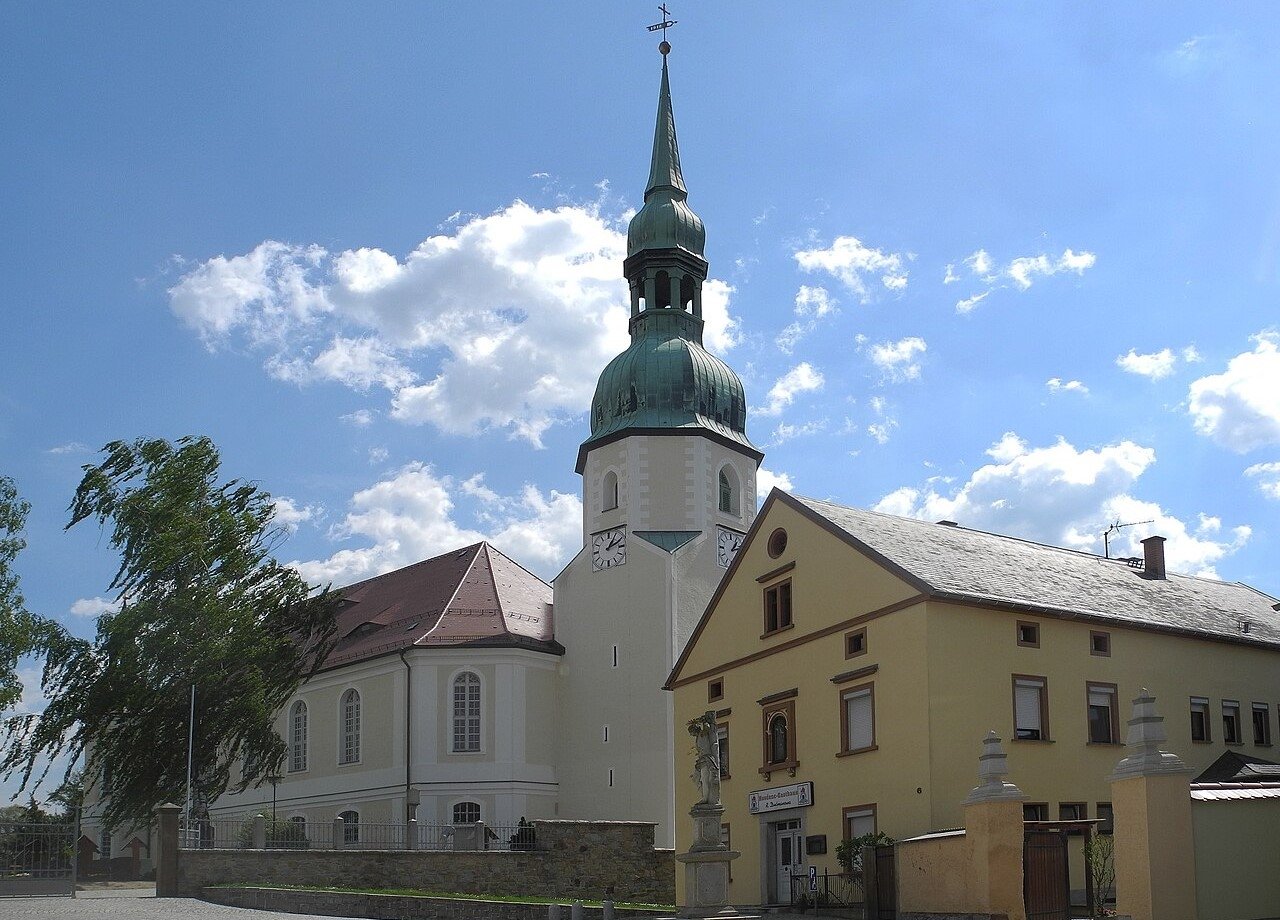
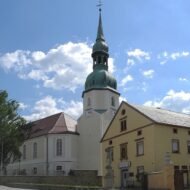
Crostwitz was first mentioned in 1225, as the seat of a local nobleman, Henricus de Crostiz. Its centre is the parish church of St. Simon and Jude, a bright Baroque building completed in 1771. It was consecrated by a bishop who had been born in the village, Jakob Wosky von Bärenstamm.
Around it, the village is quiet and well kept: farmhouses, gardens, a few shops, and the many crosses and shrines that line the roads of the Catholic Sorbian villages, often with inscriptions in Sorbian. It is not a museum village. People live and work here, and that is exactly what makes it worth visiting.
The Easter Riders of Crostwitz
The Easter riding (Křižerjo in Sorbian, Osterreiten in German) is the defining tradition of Catholic Lusatia, and one of the most remarkable religious customs still practised in Europe.
How it works. On Easter Sunday, several parishes send out their riders. Each procession rides to a neighbouring parish to announce the Resurrection, then returns home in the afternoon. Riders from Crostwitz ride to Panschwitz-Kuckau, where they are welcomed by the nuns of the Cistercian abbey of St. Marienstern, while riders from Panschwitz-Kuckau ride to Crostwitz. Along the way they sing Easter hymns and pray, almost the whole day long, in Sorbian.
Who rides. Only men take part. They are baptised Catholics from the parish, and many ride every year for decades. The tailcoats, top hats and white gloves are worn with great care, and the horses are decorated with embroidered bridles and harnesses that are often family heirlooms.
How big it is. In 2024, nine processions between the villages of Upper Lusatia brought out around 1,500 riders and nearly 50,000 spectators.
Where it comes from. Riding processions in the region are documented from the late 15th century. Their roots are probably older still: historians believe they grew out of pre-Christian field rides, meant to protect young crops from evil, which the church later turned into a procession of faith. Today the riders see it simply as a public declaration of their belief.
The year in Crostwitz
Easter is the highlight, but the Sorbian calendar runs through the whole year:
- 25 January — the Birds’ Wedding (Ptači kwas). Children dress as a bride and groom and their wedding party. In the morning, they find sweets and pastries that the “birds” have left for them.
- The weeks before Easter — Easter eggs. Sorbian eggs are decorated by hand using wax and etching techniques, in fine geometric patterns. Easter egg markets are held in Bautzen and other towns of the region.
- Easter Sunday — the Easter Riders.
- Every two years — the international folklore festival, when dance and music groups from across Europe come to Crostwitz.
- Every ten years — the Passion Play, performed by the villagers since 1995.
St. Marienstern Abbey
A few kilometres south of Crostwitz, in Panschwitz-Kuckau, the Cistercian abbey of St. Marienstern has been home to a community of nuns since its founding in 1248. It is one of the very few monasteries in Germany never to have been dissolved. Its Baroque buildings, gardens and church are open to visitors, and on Easter Sunday the nuns welcome the riders from Crostwitz. It is the natural second stop of any visit.
Visiting on Easter Sunday
The Easter riding is a religious procession, not a show. A few rules make the day better for everyone:
- Arrive early. Roads in the area are closed or crowded for most of the day. Park in advance and walk.
- Never step onto the route. Stay behind barriers and well back from the horses.
- No flash and no drones. Both can frighten the horses.
- Be quiet when the riders pass. They are praying and singing hymns.
- Dress respectfully, especially if you go into the church.
- Check the times with the parish or the regional tourism office. Departures are usually in the morning, with returns in the afternoon.
Getting there
- By train: Dresden to Kamenz takes about 45 minutes; Dresden to Bautzen about 1 hour. From either town, Crostwitz is a short bus or taxi ride.
- By car: about 45 minutes from Dresden. On Easter Sunday, expect road closures.
- On foot: the Way of St. James (Jakobsweg) passes through the village, linking Crostwitz with the wider pilgrimage routes of Saxony.
Where to stay
Most visitors stay in Bautzen, a beautiful hilltop town and the cultural capital of the Sorbs, or in Kamenz, the birthplace of the writer Gotthold Ephraim Lessing. A few guesthouses in the Sorbian villages offer a quieter stay. For Easter weekend, book well ahead.
Nearby
- Bautzen (Budyšin): the Sorbian Museum, the German–Sorbian Theatre, and one of the best-preserved old towns in Saxony.
- Panschwitz-Kuckau: St. Marienstern Abbey.
- Ralbitz: its cemetery, where every grave carries an identical white cross, a striking expression of equality in death.
- The Krabat Mill in Schwarzkollm: the setting of the Sorbian legend of Krabat, the apprentice who learned black magic in a haunted mill.
- The Spreewald: the Lower Sorbian heartland, with its waterways and traditional villages, about 1 hour 30 minutes north.
Frequently asked questions
Who are the Sorbs? The Sorbs are a West Slavic people who have lived in Lusatia, in eastern Germany, for more than 1,400 years. Around 60,000 people identify as Sorbs today, and they have their own languages: Upper Sorbian around Bautzen and Lower Sorbian around Cottbus.
When is the Easter riding in Crostwitz? Every year on Easter Sunday. In 2027, that is 28 March.
Can visitors watch the Easter Riders? Yes, the processions are public and visitors are welcome, as long as they stay off the route and respect the religious nature of the day.
Is Sorbian still spoken? Yes. In Crostwitz and the surrounding Catholic villages it is still the everyday language of many families, used at home, in church and at school.
Beyond the map
Crostwitz is a reminder that the map of Europe’s peoples doesn’t follow its borders. In the middle of Germany, an hour from Dresden, a Slavic village still sings its Easter hymns in its own language, as it has for centuries. You won’t find it on most itineraries. Arrive early on Easter Sunday, stand quietly by the road, and listen.
Part of the Civilisation Trails
This article is part of [Civilisation Trails: Slavic Europe] , our guide to the peoples, languages and faiths that shaped the Europe beyond the obvious.
Read next: Where Europe’s Folk Culture Still Lives
Carry the journey with you: Beyond the Map Field Guides
Hidden Europe — The Beyond the Map Map Crostwitz and hundreds of other coordinates, on one map of the Europe most travellers never see.
Explore more: Living Traditions · Trails · The Village Collection