

For centuries, the southern tip of Sweden was the heart of Denmark. In the winter of 1658, a Swedish army marched across the frozen sea, and Skåne changed countries forever. Its Danish castles are still standing.
Look at a map of Scandinavia today, and Skåne seems naturally Swedish: the green, rolling southern end of the country, facing Copenhagen across the Øresund. But for most of its history, it was not. Skåne was one of the core lands of the Danish kingdom. Its archbishop in Lund led the Church of all the Nordic countries. Danish kings built castles at its harbours and on its coast, and Danish nobles built strongholds in its fields.
Then, in February 1658, came one of the most extraordinary campaigns in European history. During a bitterly cold winter, the Swedish king Charles X Gustav led his army across the frozen straits from Jutland towards Zealand, the island of Copenhagen. Denmark, caught unprepared, signed the Treaty of Roskilde on 26 February 1658 (8 March in the modern calendar). It gave up Skåne, Blekinge, Halland and Bornholm, and Norway lost Bohuslän and Trøndelag. Bornholm and Trøndelag were returned two years later. Skåne never was.
On 16 April 1658, the representatives of Skåne swore loyalty to the Swedish king in Malmö. But the story did not end there. The castles they left behind still tell it.
| Place | Why go | |
|---|---|---|
| 1 | Lund Cathedral | The church of the archbishop of all Scandinavia |
| 2 | Malmöhus | The Danish royal castle of Malmö |
| 3 | Kärnan, Helsingborg | The tower that guarded the Øresund |
| 4 | Glimmingehus | The best-preserved medieval stronghold in Scandinavia |
1. Lund Cathedral
55.70° N, 13.19° E · Lund, western Skåne
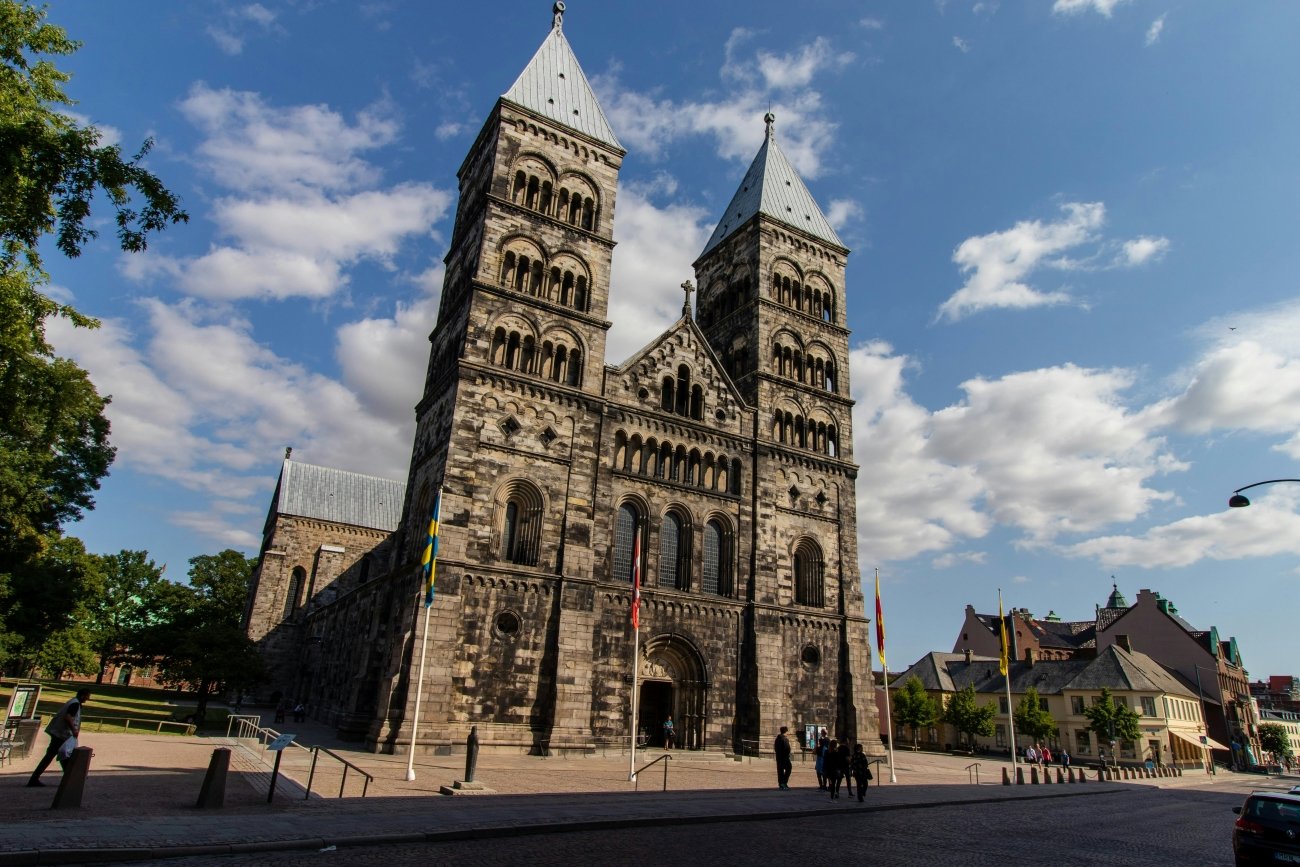
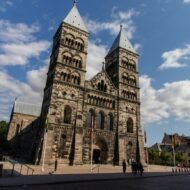
Long before Stockholm or Copenhagen mattered, Lund was the religious capital of the North. In 1103, it became the seat of an archbishop whose authority covered all the Nordic countries. Its great Romanesque cathedral rose in the following decades: the crypt’s altar was inaugurated in 1123, and the main altar was dedicated on 1 September 1145.
Go down into the crypt, and you will find a stone figure wrapped around a pillar. Legend says he is Finn, a giant who built the cathedral and, when he was not paid, tried to bring it down by shaking its columns, until he was turned to stone. Upstairs, the astronomical clock, installed around 1425, still comes to life twice a day: two knights clash their swords, the clock plays In dulci jubilo, and the Three Kings pass across its face.
Lund also tells the end of the story. In 1666, Sweden founded a university here, as a Swedish counterweight to the University of Copenhagen. And on 4 December 1676, north of the town, Swedish and Danish armies fought the Battle of Lund, one of the bloodiest battles in Scandinavian history.
→ Read more: Lund
In the Field Guide: the crypt and the clock (with the times the knights fight), the battlefield north of Lund, and the medieval streets around the cathedral.
Weather in Lund: a mild climate for Scandinavia. Average highs are about 23°C in July and August, 18°C in September and 12°C in October, falling to about 3°C in January. Rain is spread through the year, and it is often windy. Getting there: about 15 minutes by train from Malmö, and 35–40 minutes from Copenhagen Airport.
2. Malmöhus
55.60° N, 12.99° E · Malmö
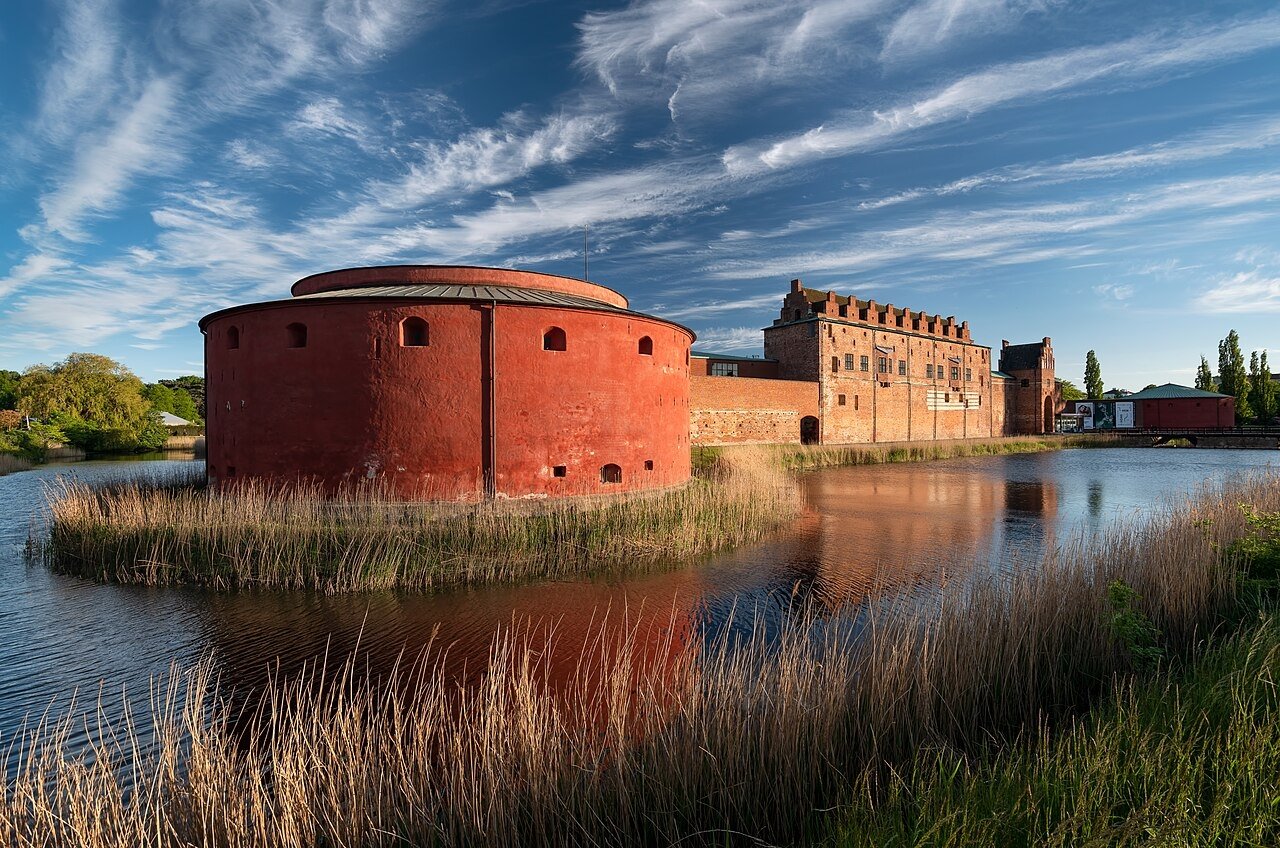
At the edge of central Malmö, surrounded by moats and green ramparts, stands the Danish royal castle of Malmöhus. A first fortress was begun here in 1434 under the Danish king Eric of Pomerania. The present main building was ordered by Frederick I and built between 1526 and 1539, and Christian III added the moats, the ramparts and the round corner towers.
Its most famous prisoner was Scottish: James Hepburn, Earl of Bothwell, the third husband of Mary, Queen of Scots, held here from 1567 to 1573. After 1658, Malmöhus lost its role as a Danish royal residence and became a Swedish fortress, and later a prison. Today it is part of the Malmö Museum.
→ Read more: Malmö
In the Field Guide: what to see inside the castle and museums, the walk around the moats, and Danish Malmö around Stortorget.
Weather in Malmö: average highs are about 23°C in July, 18°C in September, 12°C in October and 3°C in January. August and October are among the wettest months, and wind from the sea is common all year. Getting there: Malmö is about 20 minutes by train from Copenhagen Airport, across the Øresund Bridge. The castle is a short walk from the centre.
3. Kärnan, Helsingborg
56.05° N, 12.70° E · Helsingborg, on the Øresund
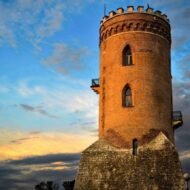
At the narrowest point of the Øresund, only a few kilometres from Denmark, a great brick tower rises above Helsingborg. Kärnan, “the Keep”, is all that is left of Helsingborg Castle, once one of the strongest fortresses of the Danish crown. Together with the Danish castle across the water at Helsingør, it controlled the passage between the North Sea and the Baltic.
The tower was built between the 1310s and around 1320, on a site already fortified in the 12th century. It is 35 metres high and 15 metres wide on each side. In the 1680s, the Swedish king Karl XI ordered the castle to be demolished. Kärnan was also due to be blown up, but the final order never came. It was restored in the 1890s, and from its top, you can look across the strait to Denmark.
In the Field Guide: the climb to the battlements, the ferry crossing to Helsingør for a two-country day, and Helsingborg’s old town below the tower.
Weather in Helsingborg: similar to Malmö, with mild summers (highs around 22–23°C) and cool, windy winters. Clear days, best for the view across the Øresund, are most common in late spring and early summer. Getting there: about 40 minutes by train from Malmö. Kärnan is open daily in summer (1 June to 1 September, 10:00–18:00), with shorter hours in autumn.
4. Glimmingehus
55.50° N, 14.23° E · Near Simrishamn, south-east Skåne
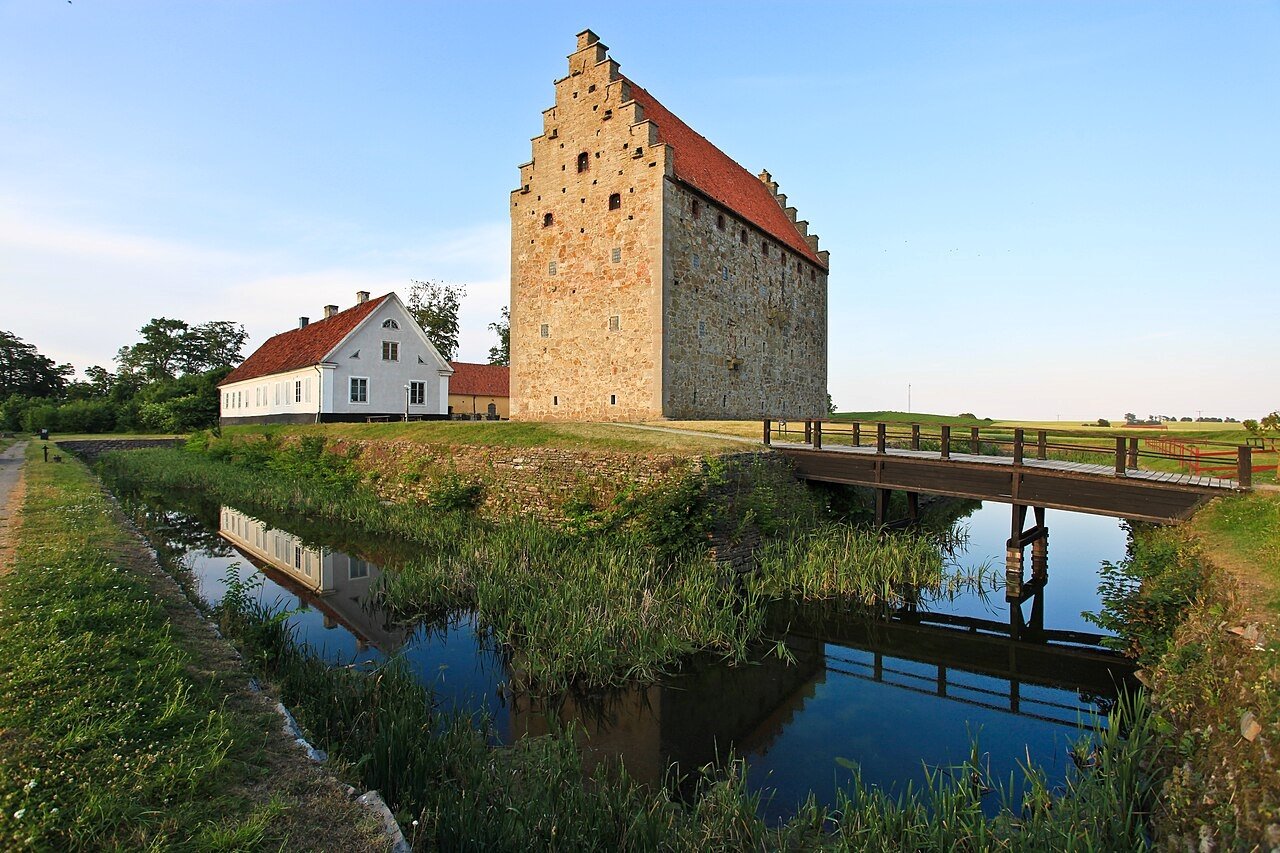
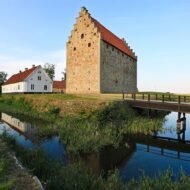
In the open farmland of south-east Skåne, a tall stone house with stepped gables stands alone behind its moat. It looks almost peaceful, until you go inside. Glimmingehus was built between 1499 and 1506 for the Danish knight and admiral Jens Holgersen Ulfstand, with the architect Adam van Düren. It is described as the best-preserved medieval stronghold in Scandinavia.
Every part of it was designed for defence: a moat and drawbridges, parapets, false doors, dead-end corridors, and holes for pouring boiling pitch on anyone who got inside. More than five hundred years later, it still stands almost exactly as it was built. Today it is cared for by the Swedish National Heritage Board.
In the Field Guide: the traps and secret passages to look for, the summer guided tours, and how to combine Glimmingehus with the apple orchards and coast of Österlen.
Weather at Glimmingehus: like the rest of Skåne, summers are mild, with highs around 22°C, and the countryside is at its best from May to September. Getting there: about an hour by car from Malmö; Simrishamn is about 15 minutes away. The castle has a museum and a restaurant, with guided tours several times a day in summer.
Along the Danish coast
The Danish centuries are written all along Skåne’s southern shore, and three short stops make an easy day from Malmö.
Foteviken and Höllviken. On 4 June 1134, in the bay of Fotevik near today’s Höllviken, two claimants to the Danish throne fought one of the decisive battles of medieval Denmark. Erik Emune won, five or six bishops died on the losing side, and Erik became King Eric II. Today the Foteviken Museum recreates a Viking Age town on the shore of the bay.
Skanör and Falsterbo. From around 1200, the tip of the Falsterbo peninsula hosted the Scania Market, a great herring fair that by the 14th century was the most important market in northern Europe. Hanseatic merchants came from Lübeck with salt and barrels, and the Danish crown grew rich on the fishing. Royal governors sat in castles at Skanör and Falsterbo; at Falsterbo, the moats and walls of Falsterbohus still mark a Danish castle on its artificial island.
Ystad. Danish until 1658, Ystad is one of the best-preserved medieval towns in Skåne, with its great church of St Mary and the Franciscan Greyfriars Abbey, founded in 1267. Today, many visitors know it as the home of Henning Mankell’s detective Kurt Wallander.
→ Read more: Höllviken · Foteviken Museum · Skanör · Falsterbo · Ystad
The war that followed
The Treaty of Roskilde changed the border, but not the people’s hearts overnight. When Denmark invaded again in 1675, during the Scanian War, many local people fought for the Danes. The Swedes called them snapphanar, a word for bandits and guerrillas. Sweden’s response was harsh: those who refused to swear loyalty were hunted down, and thousands of young Scanian men were sent to serve in distant parts of the Swedish empire. Over the following decades, the Church, the law and the language of Skåne were made Swedish.
Today, the forests of north-eastern Skåne, especially around Göinge, are still known as snapphane country, with trails and stories that remember the guerrilla war.
Beyond the map
Skåne does not feel like a border land any more. Its fields are calm, its towns are prosperous, and few visitors realise that it once belonged to another kingdom. But the castles remember. In Lund, the archbishop’s cathedral still rules the skyline. In Malmö, the Danish royal castle still sits behind its moats. In Helsingborg, Kärnan still looks across the water to Denmark. And at Glimmingehus, a Danish admiral’s fortress still waits behind its drawbridge, ready for an attack that never came.
Danish Skåne — a Beyond the Map Field Guide
[Danish Skåne — The Beyond the Map Field Guide]
The four great castles are only the beginning. Across Skåne, the Danish centuries left fortresses, planned towns and ruins that most travellers never find. The Field Guide takes you to them:
- The four landmarks, with detailed visiting notes, opening times and the best routes
- Kristianstad, the Renaissance town founded by King Christian IV of Denmark in 1614 to defend Skåne against Sweden
- Landskrona Citadel, Christian III’s fortress with its vast double moats, one of the largest preserved moat systems in Europe
- The ruins of Lillöhus, a Danish castle destroyed in the war of 1658
- Snapphane country: forest trails and hideouts of the guerrilla war in Göinge
- The Battle of Lund (1676): where it was fought, and what to see today
- A 4-day route from Copenhagen through Skåne, with a two-country day across the Øresund
- Where to stay and eat, from Malmö to Österlen
- Offline maps and GPS points for every site
→ [Get the Field Guide]
Read next: Karlskrona: Sweden’s Baroque Naval City (built in 1680 to face Denmark) · Lost Orchards of the North (Österlen) · Greece’s Catalan Castles
Explore more: Scania: our guide to Skåne · Trails · Military Heritage · Terra Incognita